Manufacturing guide · Pet
Dry pet food (kibble) contract manufacturing in India
Dry pet food (kibble) contract manufacturing in India is typically ordered in 2–5 tonne batches per recipe, with a 1 kg pouch costing roughly ₹90–180 depending on protein source and coating. Lead time runs 10–14 weeks from approved recipe to first production run, reflecting extruder scheduling and recipe trials. Pet food is not regulated by FSSAI; check current BIS standards and any import or ingredient-registration requirements before committing to a recipe.
Key facts
| Typical MOQ | 2–5 tonnes per recipe |
|---|---|
| Typical pack sizes | 400 g, 1 kg, 3 kg, 10–20 kg bulk sacks |
| Indicative cost per unit | ₹90–180 per 1 kg pouch |
| What the cost covers | Ex-factory: meat/grain meal, extrusion, coating/palatant and primary packing included; excludes GST, freight, secondary cartons, brand margin |
| Lead time, brief to first batch | 10–14 weeks from approved recipe to first production run |
| Key licences and certifications | Pet food is not regulated by FSSAI; check current BIS standards and import/registration requirements for ingredients; Legal Metrology labelling for pre-packaged goods |
| Typical shelf life | 9–12 months unopened |
| Common formats | Standard kibble, small-breed kibble, coated/palatant-enhanced kibble |
How it is made
Raw material grinding and pre-mix
Meat meal, grains or grain alternatives, vitamins and minerals are ground to a uniform particle size and dry-mixed in the formulated ratio before conditioning.
Conditioning
The pre-mix is conditioned with steam and sometimes liquid additions to the right moisture and temperature so it feeds evenly into the extruder barrel.
Extrusion and cooking
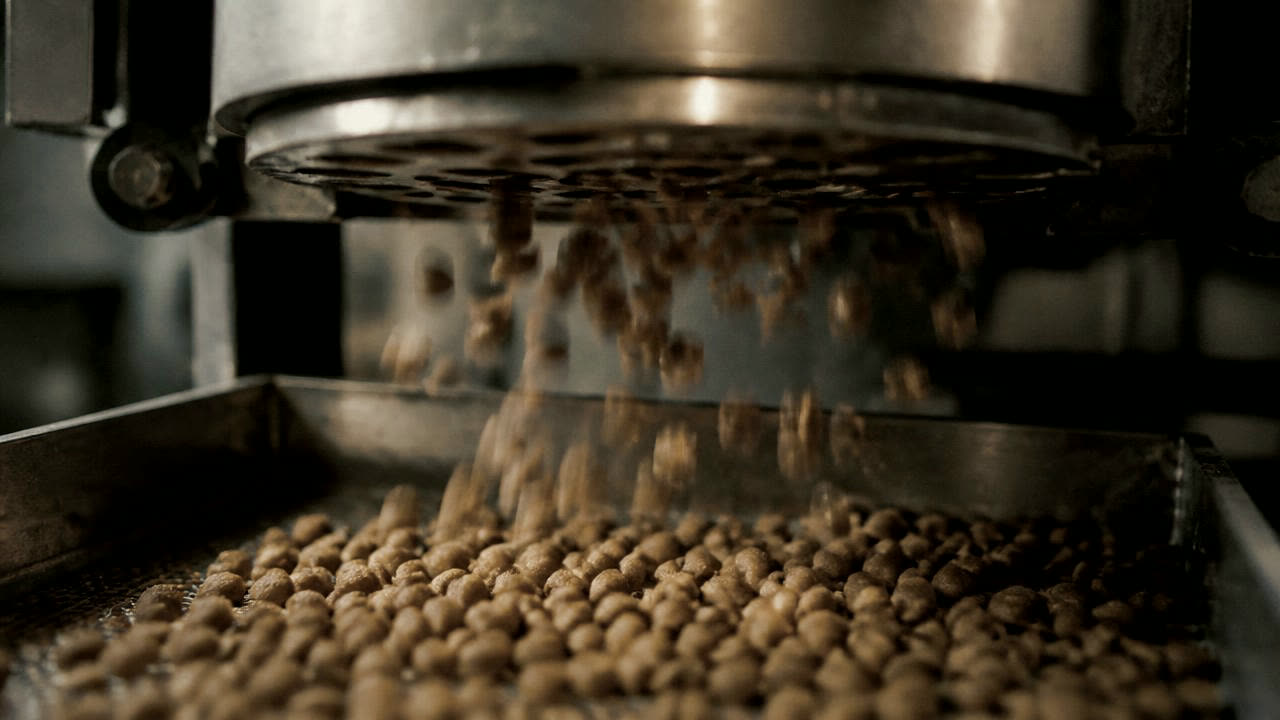
The conditioned mix passes through the extruder barrel under heat and pressure, cooking the starches and shaping the kibble as it exits through a die and is cut to size by a rotating knife.
Drying and cooling
Freshly extruded kibble is dried to the target moisture level and then cooled before coating, since kibble packed while still warm or moist is prone to mould growth.
Coating and palatant application
Fat, palatant or flavour coatings are sprayed on in a rotating drum once the kibble has cooled, giving the final taste and aroma profile.
Packing and batch coding
Cooled, coated kibble is weighed and packed into pouches or bulk sacks with batch coding, then sealed for shipping.
What drives the cost
raises cost
Protein source
Single-source or higher meat-meal-content recipes cost more per kg than grain-heavy or blended-protein formulations.
raises cost
Palatant and coating complexity
Multi-stage coating with fat sprays and flavour palatants adds a distinct processing and raw material cost line over plain kibble.
raises cost
Kibble size and die customisation
Small-breed or custom-shaped kibble needs dedicated die tooling and slower extruder throughput than standard kibble shapes.
lowers cost
Batch tonnage
Larger recipe batches spread extruder changeover and drying-line setup time over more kg of output, lowering cost per kg.
depends
Packaging format
Bulk sacks cost less per kg in packaging than smaller retail pouches, but retail pouches may be necessary for the target channel.
Common mistakes first-time brands make
Underestimating drying time before packing
Packing kibble before it reaches the target moisture level risks mould growth in the pack during transit or storage; always confirm moisture testing before sealing.
Not confirming registration requirements early
Pet food is outside FSSAI regulation; verify applicable BIS standards and any import or ingredient-registration requirements early, rather than assuming a general pet-food licence exists.
Skipping palatability trials
A recipe that looks right on paper can still underperform on palatability; small-batch trials before committing to a 2–5 tonne run reduce this risk.
Choosing a manufacturer for dry pet food (kibble)
Extruder capability and die range
Check what kibble sizes and shapes the extruder can produce and whether small-breed or custom dies need new tooling.
Registration and standards awareness
Confirm the manufacturer can document applicable BIS standards and any import or ingredient-registration requirements for your recipe.
Batch tonnage flexibility
Ask whether the manufacturer can run at your MOQ (often 2–5 tonnes) without forcing a much larger minimum batch.
Coating and palatant trial samples
Request coated kibble samples from a small trial run before committing to full batch production, since coating uniformity varies by equipment.
Frequently asked questions
- What licence do I need to sell dry pet food in India?
- Pet food is not regulated by FSSAI. Check current BIS standards and any import or ingredient-registration requirements with the relevant authorities; do not assume a general FSSAI or pet-food manufacturing licence applies.
- Why is the MOQ for pet food measured in tonnes rather than units?
- Extrusion lines are set up and run efficiently at a minimum batch tonnage per recipe, so manufacturers typically quote MOQ in tonnes (commonly 2–5 tonnes) rather than unit counts.
- What causes kibble to go soft or mouldy after packing?
- This is usually from packing before the kibble has dried to the target moisture level, or from a damaged moisture barrier in the pack; both are checked during drying and packing-line quality control.
- Can I order a small-breed kibble size from the start?
- Yes, but small-breed kibble needs its own die and generally slower extruder throughput, so confirm tooling lead time separately from your main production schedule.
- How long does recipe development take before the first production run?
- Recipe trials and palatability checks typically take a few weeks before the formulation is locked, which is part of why lead time runs 10–14 weeks overall.
How BrandForge helps
BrandForge matches your pet food brief against extruders whose die range and batch tonnage fit your recipe, sharing partner identities only once both sides approve. A success manager then helps track recipe trials, coating samples and registration checks through to your first production run.