Manufacturing guide · Colour cosmetics
Kajal and eyeliner pencils contract manufacturing in India
Kajal and eyeliner pencils are typically contract manufactured in India at 5,000–20,000 units per shade, costing around ₹12–30 per pencil whether wooden-cased or twist-up. Lead time runs 8–14 weeks once the wax-pigment bulk is approved, and a cosmetics manufacturing licence issued by the State Licensing Authority under the Cosmetics Rules, 2020 is a baseline check. Twist-up formats generally cost more than wooden pencils because of the plastic mechanism and assembly steps involved.
Key facts
| Typical MOQ | 5,000–20,000 units per shade |
|---|---|
| Typical pack sizes | Standard wooden pencil or twist-up stick, 1.1–3 g payload |
| Indicative cost per unit | ₹12–30 per pencil |
| What the cost covers | Ex-factory: bulk extrusion/moulding, casing (wood or plastic mechanism) and sharpening/capping included; excludes GST, freight, cartons, brand margin |
| Lead time, brief to first batch | 8–14 weeks from approved bulk to first batch |
| Key licences and certifications | Cosmetics manufacturing licence issued by the State Licensing Authority under the Cosmetics Rules, 2020; Legal Metrology labelling for pre-packaged goods |
| Typical shelf life | 24–36 months unopened |
| Common formats | Wooden pencil (sharpenable), twist-up mechanical, kohl stick |
How it is made
Bulk compounding
Waxes, oils and pigments (or kohl/carbon-based colourants) are melted and milled into a smooth, dark-pigmented bulk tested for colour depth and smooth glide on a draw-down card.
Extrusion or mould casting
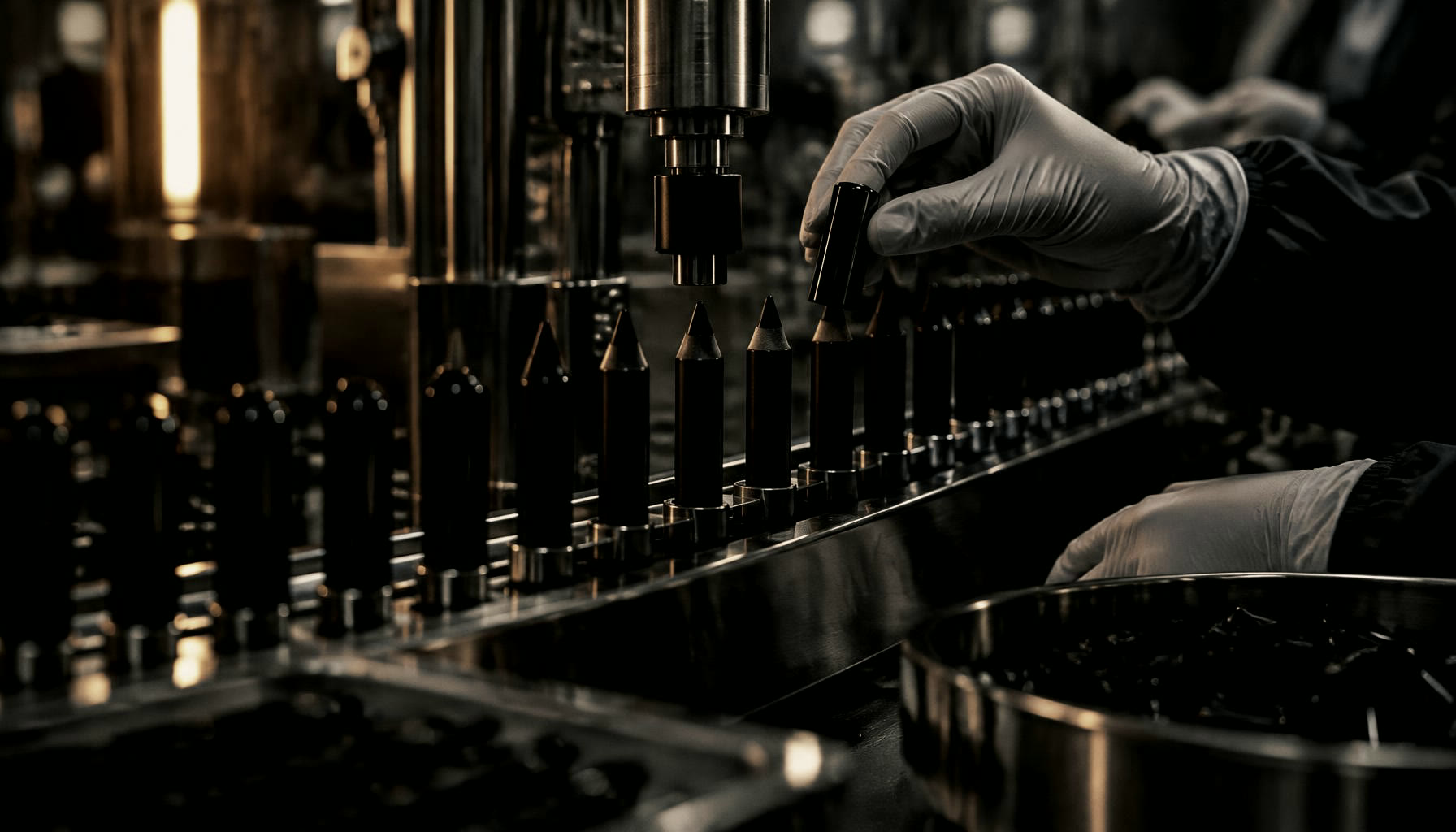
For wooden pencils, the bulk is extruded into a lead and inserted into pre-grooved wood slats that are glued and shaped round; for twist-up formats, bulk is cast directly into a plastic barrel with a propel mechanism.
Sharpening and capping
Wooden pencils go through a sharpening and pointing line; twist-up sticks are capped and the mechanism is tested for smooth, non-jamming advance.
Smoothness and breakage testing
Pencils are checked for lead breakage under pressure and smooth glide without dragging, since a brittle lead is a common complaint for dark kajal formulations.
Batch coding and packing
Approved pencils are batch coded, capped or sheathed, and packed into trays for secondary packaging.
What drives the cost
raises cost
Twist-up mechanism vs wooden casing
The plastic barrel and propelling mechanism in twist-up formats cost more per unit than a simple wooden slat casing.
depends
Lead hardness tuning
Softer leads glide more easily but break more during sharpening and shipping, so getting the wax ratio right can raise or lower rework cost.
raises cost
Sharpener or cap inclusion
Bundling a built-in sharpener cap or smudger tip adds a bought-out component cost per unit.
raises cost
Number of shades
Each shade needs its own bulk run and line changeover, so small multi-shade kajal ranges cost more per unit than a single dominant black shade.
lowers cost
Order volume per shade
Larger single-shade runs amortise extrusion die setup and line changeover across more units.
Common mistakes first-time brands make
Not testing lead breakage in transit
Pencils that pass in-factory drop tests can still snap during distribution if the wax-to-pigment ratio is too brittle; ask for a transit-simulation check.
Overlooking sharpener compatibility
Wooden pencil diameter and wood hardness need to suit standard sharpeners, or customers will report jamming or excess shaving.
Skipping smudge-resistance checks on dark pigment loads
Very high pigment concentration can affect how cleanly the product glides and sets, so pilot batches should be checked before locking the bulk recipe.
Choosing a manufacturer for kajal and eyeliner pencils
Extrusion and casing capability
Check whether the manufacturer runs both wooden-pencil and twist-up lines in-house, since few units handle both well.
Cosmetic licence and batch testing
Confirm a current Cosmetics manufacturing licence issued by the State Licensing Authority under the Cosmetics Rules, 2020 and that each batch is checked for colour depth and lead integrity before packing.
Capacity per shade per week
Ask for weekly output per shade so your delivery schedule across a multi-shade kajal range is realistic.
Pre-production glide and breakage samples
Insist on physical pencil samples tested for glide and breakage, not just a bulk swatch, before bulk MOQ production starts.
Frequently asked questions
- Is kajal regulated differently from eyeliner in India?
- Both are treated as cosmetics for eye-area use, so the same Cosmetics manufacturing licence issued by the State Licensing Authority under the Cosmetics Rules, 2020 framework applies to the unit making either format.
- Which format is cheaper, wooden pencil or twist-up?
- Wooden pencils are usually cheaper per unit since they avoid the plastic mechanism and extra assembly steps that twist-up sticks need.
- How is kajal bulk different from a typical wax lip bulk?
- Kajal bulk uses a much higher pigment or carbon-black load and is tuned for glide and smudge control around the eye, rather than for colour payoff and shine like lip bulks.
- Can I order a single black shade to start?
- Yes, starting with one core shade is common and keeps the per-unit cost lower since there's no changeover across multiple colour bulks.
- What causes pencils to break during sharpening?
- Brittle lead from an unbalanced wax ratio or wood that's too hard around the lead core are the usual causes; a manufacturer should test both before bulk production.
How BrandForge helps
BrandForge matches your kajal or eyeliner brief against manufacturers who run both wooden-pencil and twist-up lines, revealing partner details only once both sides approve the fit. A success manager then follows your shade and glide samples through to first batch sign-off.