Manufacturing guide · Colour cosmetics
Lipstick contract manufacturing in India
Lipstick contract manufacturing in India typically runs 3,000–10,000 bullets per shade, costing roughly ₹35–90 per 3.5–4.5 g bullet depending on pigment load and finish. Expect 8–14 weeks from approved bulk and shade card to first filled batch. A cosmetics manufacturing licence issued by the State Licensing Authority under the Cosmetics Rules, 2020 is the baseline requirement before any bulk is poured.
Key facts
| Typical MOQ | 3,000–10,000 bullets per shade |
|---|---|
| Typical pack sizes | 3.5–4.5 g bullet in a case/bullet mould |
| Indicative cost per unit | ₹35–90 per bullet (3.5–4.5 g) |
| What the cost covers | Ex-factory: wax-oil-pigment bulk, bullet moulding, case assembly and primary packing included; excludes GST, freight, outer cartons, brand margin |
| Lead time, brief to first batch | 8–14 weeks from approved shade and bulk to first batch |
| Key licences and certifications | Cosmetics manufacturing licence issued by the State Licensing Authority under the Cosmetics Rules, 2020; Legal Metrology labelling for pre-packaged goods |
| Typical shelf life | 24–36 months unopened |
| Common formats | Matte, satin, sheen and long-wear bullet finishes; twist-up cases |
How it is made
Bulk melt and dispersion
Waxes (candelilla, carnauba, beeswax or vegetable alternatives), oils and pigments are melted and milled on a roller or bead mill until the colour bulk is streak-free and the shade matches the approved standard.
De-airing and tempering
The molten bulk is vacuum de-aired to avoid pinholes, then held at a tempering temperature so the pour is fluid enough to fill fine mould cavities without trapping air.
Mould filling and chilling
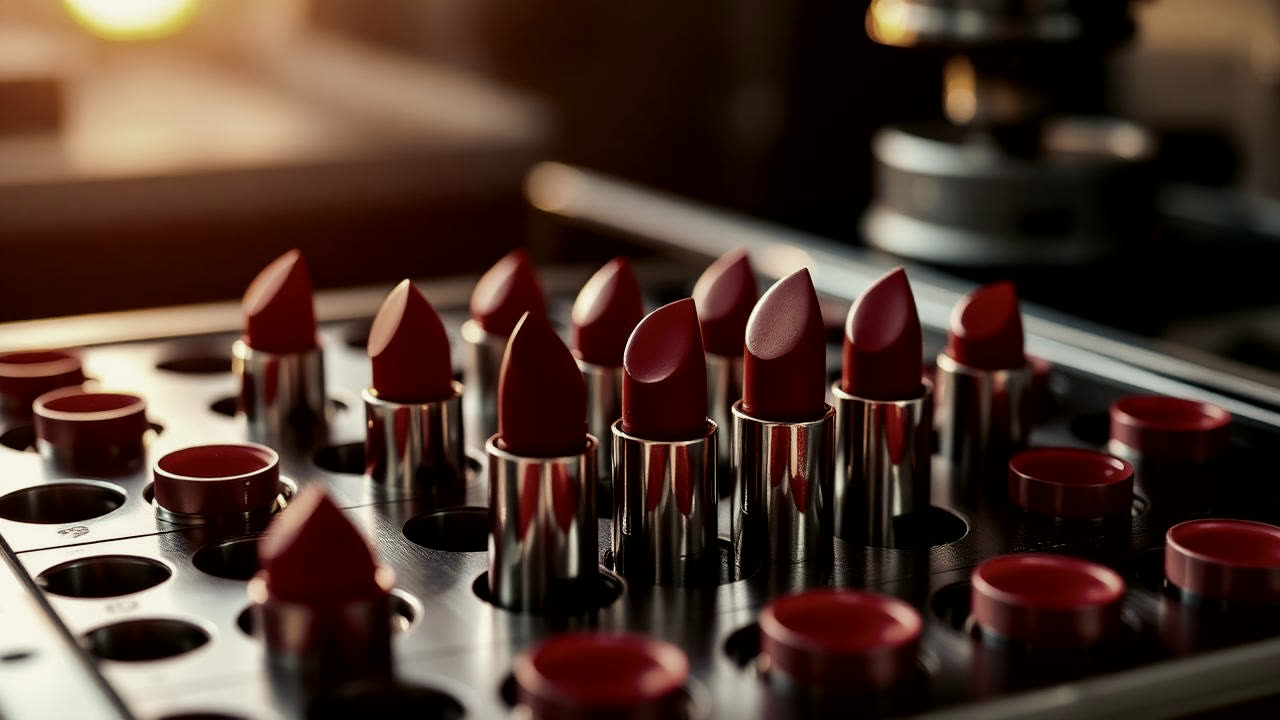
Bulk is poured into heated bullet moulds, chilled on a cooling tunnel or plate, then demoulded; this is where sink marks, cracking and crystallisation ('blooming') show up first.
Flaming and inspection
Bullets pass briefly through a flame to smooth the surface and remove demoulding marks, then go through visual and shade-match inspection before casing.
Case assembly and batch coding
Bullets are seated into cases, capped, batch coded and packed into trays or cartons ready for shipping.
What drives the cost
raises cost
Pigment and pearl load
High-chroma or pearlescent shades need more pigment dispersion time and tighter shade-match tolerance, raising bulk cost.
raises cost
Case tooling
Custom or metallic cases need dedicated tooling or higher-cost bought-out components versus standard stock cases.
raises cost
Number of shades in the order
Each shade needs its own bulk batch, mill cleandown and mould changeover, so small multi-shade orders cost more per bullet than one large single-shade run.
lowers cost
Bullet mould cavity count
Higher-cavity moulds fill more bullets per cycle, spreading the tooling and labour cost over more units at volume.
depends
Finish type
Matte bulks often need more wax and milling passes than sheer/satin bulks, shifting cost either way depending on the formulation.
Common mistakes first-time brands make
Approving shade under the wrong light
Shade cards checked only under one light source can mismatch badly under daylight or warm store lighting; ask for a multi-light shade approval.
Ignoring bloom testing
Wax bloom (a dull film forming on the bullet surface over weeks) often appears only after storage; skipping accelerated stability checks risks a shelf complaint months later.
Underestimating mould lead time
New bullet shapes or custom cases need mould fabrication time that is easy to miss when planning a launch date.
Choosing a manufacturer for lipstick
Shade-matching capability
Confirm the manufacturer has an in-house colour lab with spectrophotometer matching, not just visual approval, especially for multi-shade ranges.
Cosmetic licence and GMP
Check the Cosmetics manufacturing licence issued by the State Licensing Authority under the Cosmetics Rules, 2020 is current for the category and that the unit follows ISO 22716 cosmetic GMP practices.
Bullet and case capacity
Ask how many bullet moulds and case formats are on hand versus what needs new tooling for your SKU count.
Shade sampling process
A manufacturer should supply physical bullet samples (not just swatches) against your reference shade before bulk approval.
Frequently asked questions
- Can I launch with just 2–3 shades?
- Yes, most manufacturers will run a small shade range, but each shade still carries its own MOQ since bulk and mould changeover happens per shade.
- Do I need a cosmetic licence to sell lipstick in India?
- Yes, lipstick is regulated as a cosmetic, so the manufacturing unit needs a valid licence issued by the State Licensing Authority under the Cosmetics Rules, 2020; as a brand owner you typically rely on your contract manufacturer's licence while your own labelling follows Legal Metrology rules.
- How long does shade development take before bulk MOQ production?
- A new shade typically takes 2–4 weeks of lab trials and sample rounds before the bulk recipe is locked for production.
- What causes lipstick to sweat or bloom in storage?
- Sweating (oil migration) and blooming (wax crystallisation) usually stem from an imbalanced wax-oil ratio or poor tempering; accelerated stability testing at the manufacturer should catch this before launch.
- Can the same line make lip balm and lipstick?
- Some lines handle both since the wax-oil bulk process is similar, but pigment dispersion equipment for lipstick is usually dedicated to avoid cross-shade contamination.
How BrandForge helps
BrandForge takes your shade range and brief once and matches it double-blind against verified colour-cosmetics manufacturers whose mould inventory and shade-matching lab fit your range. Partner identities are shared only after both sides approve, and a success manager then tracks shade approval and bulk sign-off through to first batch.