Manufacturing guide · Nutraceuticals
Tablets contract manufacturing in India
Tablet nutraceuticals are usually contract manufactured at an MOQ of 5,000–10,000 bottles, with a 60-count bottle costing roughly ₹45–150 ex-factory depending on coating and actives load. A first batch typically takes 8–14 weeks once the formulation, granulation trial and FSSAI licence are in order.
Key facts
| Typical MOQ | 5,000–10,000 bottles of 60 units (around 150–300 kg of blend at 0.5 g per unit, before losses) |
|---|---|
| Typical pack sizes | 30-count, 60-count, 90-count bottles; blister strips of 10 or 15 |
| Indicative cost per unit | ₹45–150 per 60-count bottle (ex-factory) |
| What the cost covers | Ex-factory: granulation, compression, film coat (if any), bottle/blister, cap and label included; excludes GST, freight, shipper carton, brand margin |
| Lead time, brief to first batch | 8–14 weeks from brief and granulation trial to first compressed batch |
| Key licences and certifications | FSSAI licence; product must comply with the FSS (Health Supplements, Nutraceuticals, Food for Special Dietary Use, Food for Special Medical Purpose, Functional Food and Novel Food) Regulations; Legal Metrology labelling for pre-packaged goods |
| Typical shelf life | 18–24 months from manufacture |
| Common formats | Tablet only; uncoated, film-coated or chewable; HDPE bottle or alu-alu blister |
How it is made
Formulation and granulation
Actives and binders are wet- or dry-granulated to get flowable, compressible granules; granulation method is chosen based on moisture sensitivity of the actives.
Drying and sizing
Wet granules are dried in a fluid-bed drier and passed through a sieve to get a uniform granule size for consistent tablet weight.
Blending with lubricant
Dried granules are blended with a lubricant such as magnesium stearate so the mix flows evenly into the tablet press die cavity.
Compression
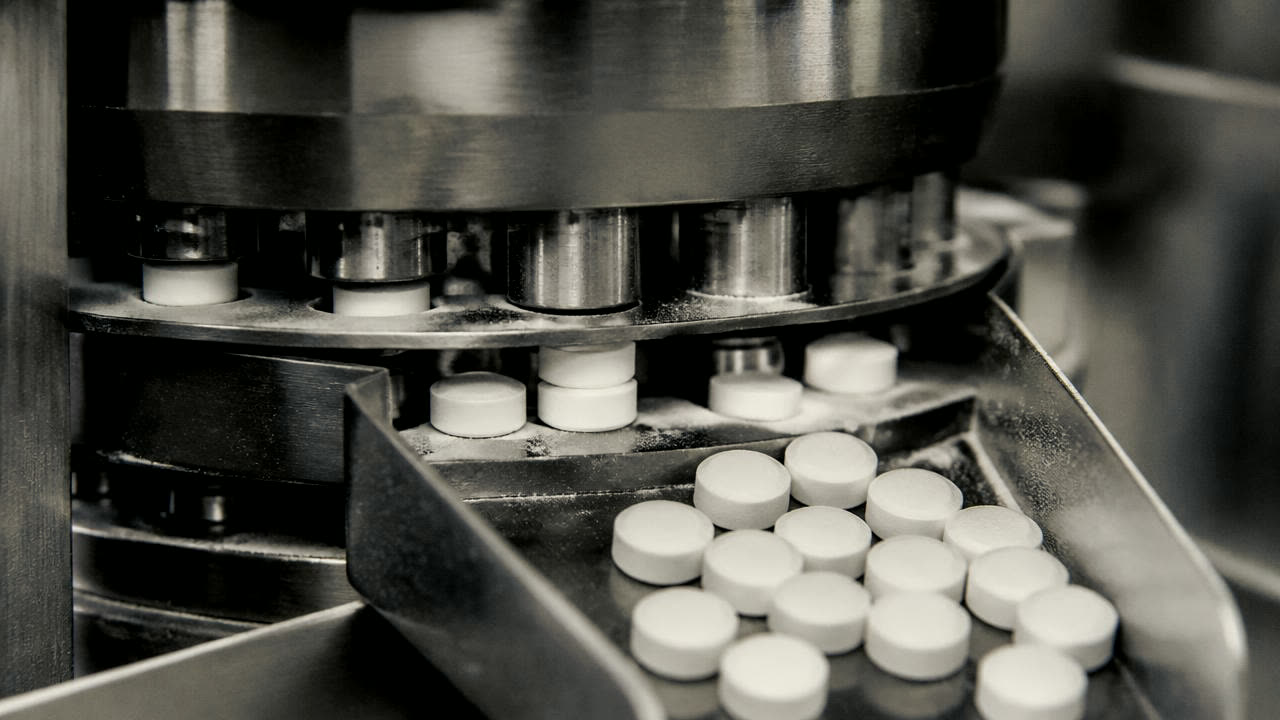
A rotary tablet press compresses the blend into tablets at a set hardness and thickness, with in-process checks for weight, hardness and friability.
Coating (optional)
Tablets needing a film coat pass through a coating pan where a polymer film is sprayed on to mask taste or aid swallowing; chewable tablets skip this step.
Packing and batch release
Tablets are counted into bottles or blister-packed, and a sample is tested for assay, disintegration and hardness before release.
What drives the cost
depends
Granulation method (wet vs direct compression)
Direct compression skips drying and lowers cost for compatible actives, while wet granulation suits moisture-tolerant, poorly flowing powders.
raises cost
Film coating
Adding a taste-mask or colour coat adds a coating-pan cycle and polymer cost per thousand tablets.
raises cost
Tablet size and actives load
Larger tablets carrying a higher actives dose need more granule and compression force, raising per-unit material cost.
lowers cost
Batch size
A full compression run amortises die-set changeover and in-process testing across more tablets.
depends
Blister vs bottle packing
Alu-alu blister packs cost more per unit than bottles but offer better moisture protection for sensitive actives.
raises cost
Hardness and friability rework
Tablets failing hardness or friability checks are scrapped and re-granulated, adding cost on early production runs.
Common mistakes first-time brands make
Underestimating granulation trial time
Brands who skip a granulation trial often find the blend doesn't compress cleanly, causing capping or lamination on the first commercial run.
Choosing coating for taste masking without testing swallowability
A coat chosen only to mask taste can change tablet size and hardness in ways that affect how easily it's swallowed.
Not specifying hardness and friability limits upfront
Without agreed in-process limits, tablets may pass the press but crumble in transit or on the shelf.
Overlooking die wear on long runs
Running a large batch on worn punches can cause weight drift partway through; ask the manufacturer about punch maintenance schedules.
Choosing a manufacturer for tablets
Compression capability
Confirm the rotary press tonnage and die-set range matches your tablet size, and whether they can run both coated and uncoated tablets.
Certifications
An FSSAI licence is the baseline; GMP certification signals documented in-process control over hardness and weight.
Capacity fit
Check their minimum granulation batch size against your 5,000–10,000 bottle MOQ so a small order isn't run at a loss and rushed.
Sampling and in-process data sharing
Ask for a pilot batch with hardness, friability and disintegration data shared, not just a finished sample.
Frequently asked questions
- What is the MOQ for tablet nutraceuticals?
- Most manufacturers quote 5,000–10,000 bottles as MOQ, or by granulation batch weight of 300–1,000 kg for costlier actives.
- Should I choose a coated or uncoated tablet?
- Coated tablets mask taste and ease swallowing but add coating-pan cost; uncoated or chewable tablets suit actives without a strong off-taste.
- How long does tablet manufacturing take from brief to delivery?
- Expect 8–14 weeks, most of it spent on the granulation trial, compression setting and coating trial before the commercial batch is compressed.
- What licence is needed for tablet nutraceuticals?
- An FSSAI licence under the food supplement category is required; GMP certification is often expected by retail and export buyers.
- Can the same formulation be run as both tablet and capsule?
- Often yes with reformulation, since tablets need a compressible granule while capsules just need a flowable powder fill.
How BrandForge helps
BrandForge matches your tablet brief against verified compression and coating specialists, screening on press tonnage, coating-pan capability and your target hardness and friability limits before any names are exchanged. Once you approve a shortlist, a success manager stays involved through the granulation trial to first compressed batch.