Manufacturing guide · Nutraceuticals
Softgel capsules contract manufacturing in India
Softgel capsules are typically contract manufactured at a 10,000–30,000 unit MOQ (around 167–500 bottles of 60-count), costing ₹90–220 ex-factory per bottle depending on fill type and shell material. Lead time runs 8–14 weeks from brief to first batch, and the manufacturer needs an FSSAI licence with a rotary-die encapsulation line.
Key facts
| Typical MOQ | 10,000–30,000 capsules per fill formulation (roughly 167–500 bottles of 60-count) |
|---|---|
| Typical pack sizes | 60-count and 90-count bottles; blister strips of 10 for some formats |
| Indicative cost per unit | ₹90–220 ex-factory for a 60-count bottle |
| What the cost covers | Ex-factory: oil or liquid fill, gelatin or vegetarian (starch/carrageenan-based) shell, bottle, cap and desiccant, encapsulation and printing included; excludes GST, freight, outer cartons, brand margin |
| Lead time, brief to first batch | 8–14 weeks from brief to first batch (longer for a vegetarian shell formulation or a new fill viscosity) |
| Key licences and certifications | FSSAI licence; product must comply with the FSS (Health Supplements, Nutraceuticals, Food for Special Dietary Use, Food for Special Medical Purpose, Functional Food and Novel Food) Regulations; Legal Metrology labelling for pre-packaged goods |
| Typical shelf life | 18–24 months stored cool and dry, away from direct heat that can soften the shell |
| Common formats | Gelatin shell or vegetarian (starch/carrageenan-based) shell; oil-fill, suspension-fill or blend-fill capsules |
How it is made
Fill-mass preparation
The oil or liquid blend carrying the active ingredients is mixed and de-aerated to the viscosity the encapsulation machine needs.
Gelatin mass preparation
Gelatin (or a validated starch/carrageenan system for vegetarian shells) is prepared with plasticiser and colour to form the ribbon material fed into the encapsulation machine.
Rotary-die encapsulation
Two gelatin ribbons are fed through a rotary die that simultaneously forms, fills and seals the softgel shell around the fill mass.
Drying/tumbling
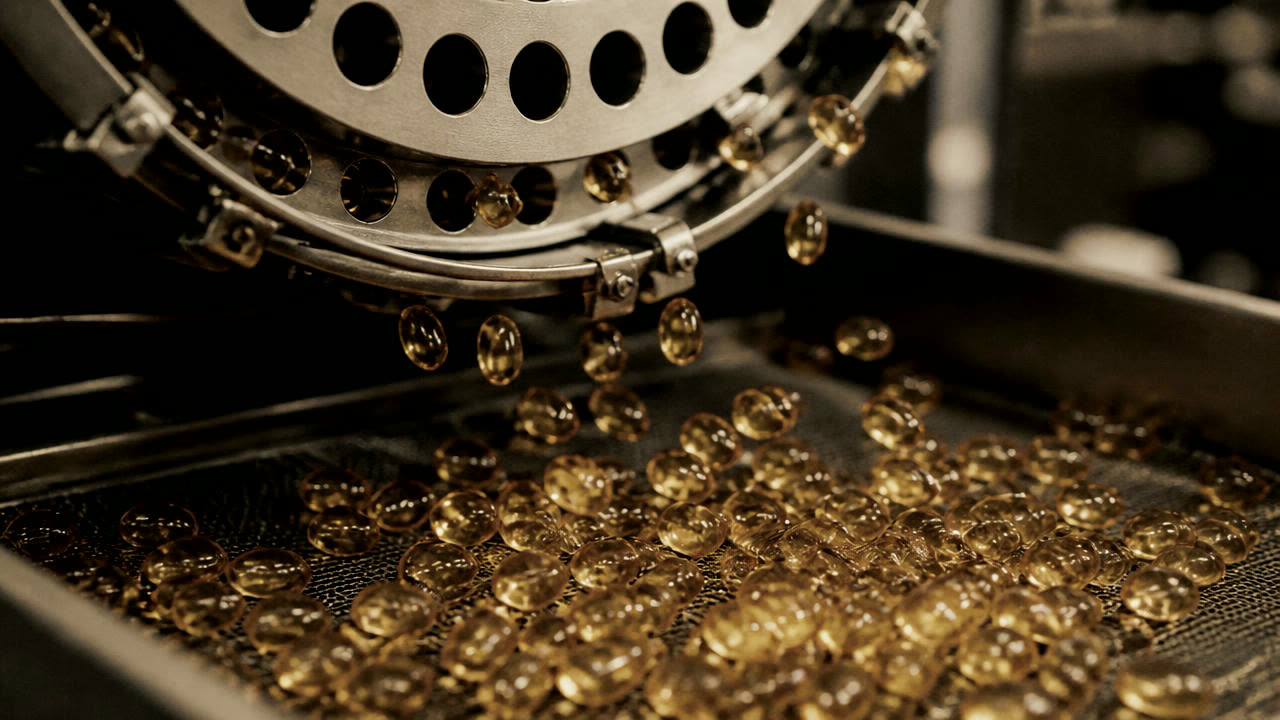
Freshly formed softgels are tumble-dried in rotating pans over one to two days to reduce moisture and harden the shell to its target texture.
Inspection and polishing
Capsules are inspected for leaks, seam defects and shape, then polished before moving to the bottling line.
Bottling and sealing
Capsules are counted and filled into bottles with a desiccant, induction-sealed, capped and batch-coded.
What drives the cost
depends
Shell material
Vegetarian starch/carrageenan-based shells cost more than gelatin shells but are necessary if the brand wants a non-animal-derived product.
raises cost
Fill viscosity and type
Suspension fills with suspended solids are harder to meter accurately than plain oil fills, which raises encapsulation line cost.
raises cost
Drying/tumbling time
A thicker shell or higher-moisture fill needs longer tumble-drying time, which ties up drying-pan capacity and raises per-batch cost.
lowers cost
Batch size
Running a larger fill-mass batch spreads the die-change and cleaning cost of the encapsulation machine over more capsules.
raises cost
Leak-testing rigour
Stricter leak and seam inspection (sometimes with automated vision systems) adds inspection cost but reduces returns from leaking capsules.
Common mistakes first-time brands make
Not specifying shell type upfront
Switching from gelatin to a vegetarian shell mid-project changes the encapsulation parameters significantly; decide shell material before formulation starts.
Underestimating drying time in lead-time planning
Buyers sometimes forget the one-to-two-day tumble-drying step when estimating total lead time; always ask for the full schedule including drying.
Overlooking fill-mass compatibility with the shell
Certain oils or high-water-content fills can interact with gelatin shells over time; ask the manufacturer to confirm fill-shell compatibility and run a stability check.
Choosing a manufacturer for softgel capsules
Capabilities
Confirm the plant runs rotary-die encapsulation sized for your batch and can handle your specific fill type (oil, suspension or blend).
Certifications
FSSAI licence is the baseline; GMP certification is a strong indicator of process control on an encapsulation line.
Capacity
Check daily encapsulation output and drying-pan capacity against your order volume, since drying is often the bottleneck step.
Sampling
Request a small trial batch with leak and seam inspection results before committing to the full production run.
Frequently asked questions
- What is the difference between gelatin and vegetarian softgel shells?
- Gelatin shells are animal-derived and generally cost less, while vegetarian shells use validated starch/carrageenan polymer systems and cost more but suit non-animal product positioning.
- How long does softgel drying take?
- Tumble-drying typically takes one to two days depending on shell thickness and fill moisture, and this step should be included in your lead-time planning.
- Can softgels carry suspended powders, not just oils?
- Yes, suspension-fill softgels can carry fine powders suspended in an oil base, though metering accuracy needs closer control than a plain oil fill.
- What is a typical MOQ for a softgel formulation?
- MOQ is usually set at 10,000–30,000 capsules per fill formulation, which is roughly 167–500 bottles at a 60-count fill, before rejects.
- How is leak risk managed during production?
- Manufacturers inspect capsules for seam and leak defects after drying, sometimes using automated vision systems, before capsules move to bottling.
How BrandForge helps
BrandForge matches your softgel brief — shell type, fill viscosity and batch size — double-blind against manufacturers verified for rotary-die encapsulation and leak-inspection rigour. Once both sides approve the match, a success manager helps plan around the drying-time bottleneck so your launch schedule stays realistic.