Manufacturing guide · Nutraceuticals
Nutraceutical gummies contract manufacturing in India
Nutraceutical gummies are typically contract manufactured at a 5,000–10,000 unit MOQ (counted in 30-count jars), costing ₹90–180 ex-factory per jar depending on active-ingredient loading and gelling agent used. Lead time runs 8–14 weeks from brief to first batch, and the plant needs an FSSAI licence with a starch-mogul or mould-depositing line.
Key facts
| Typical MOQ | 5,000–10,000 jars (30-count) per SKU |
|---|---|
| Typical pack sizes | 30-count and 60-count jars; single-serve sachets of 2–4 gummies for sampling |
| Indicative cost per unit | ₹90–180 ex-factory for a 30-count jar |
| What the cost covers | Ex-factory: gelling agent (pectin or gelatin), sugar/sweetener syrup, active ingredients, flavour and colour, jar and desiccant, depositing and packing included; excludes GST, freight, outer cartons, brand margin |
| Lead time, brief to first batch | 8–14 weeks from brief to first batch (longer for a pectin-based vegetarian formulation) |
| Key licences and certifications | FSSAI licence; product must comply with the FSS (Health Supplements, Nutraceuticals, Food for Special Dietary Use, Food for Special Medical Purpose, Functional Food and Novel Food) Regulations; Legal Metrology labelling for pre-packaged goods |
| Typical shelf life | 12–18 months stored cool and dry, shorter in high-humidity climates without a desiccant |
| Common formats | Pectin-based (vegetarian) or gelatin-based gummies; single-flavour or layered dual-flavour |
How it is made
Syrup cooking
Sugar, glucose syrup and the chosen gelling agent (pectin or gelatin) are cooked together to a target brix and set strength.
Active-ingredient dosing
Vitamins, minerals or botanical actives are metered into the syrup at a controlled temperature to avoid degrading heat-sensitive ingredients.
Depositing
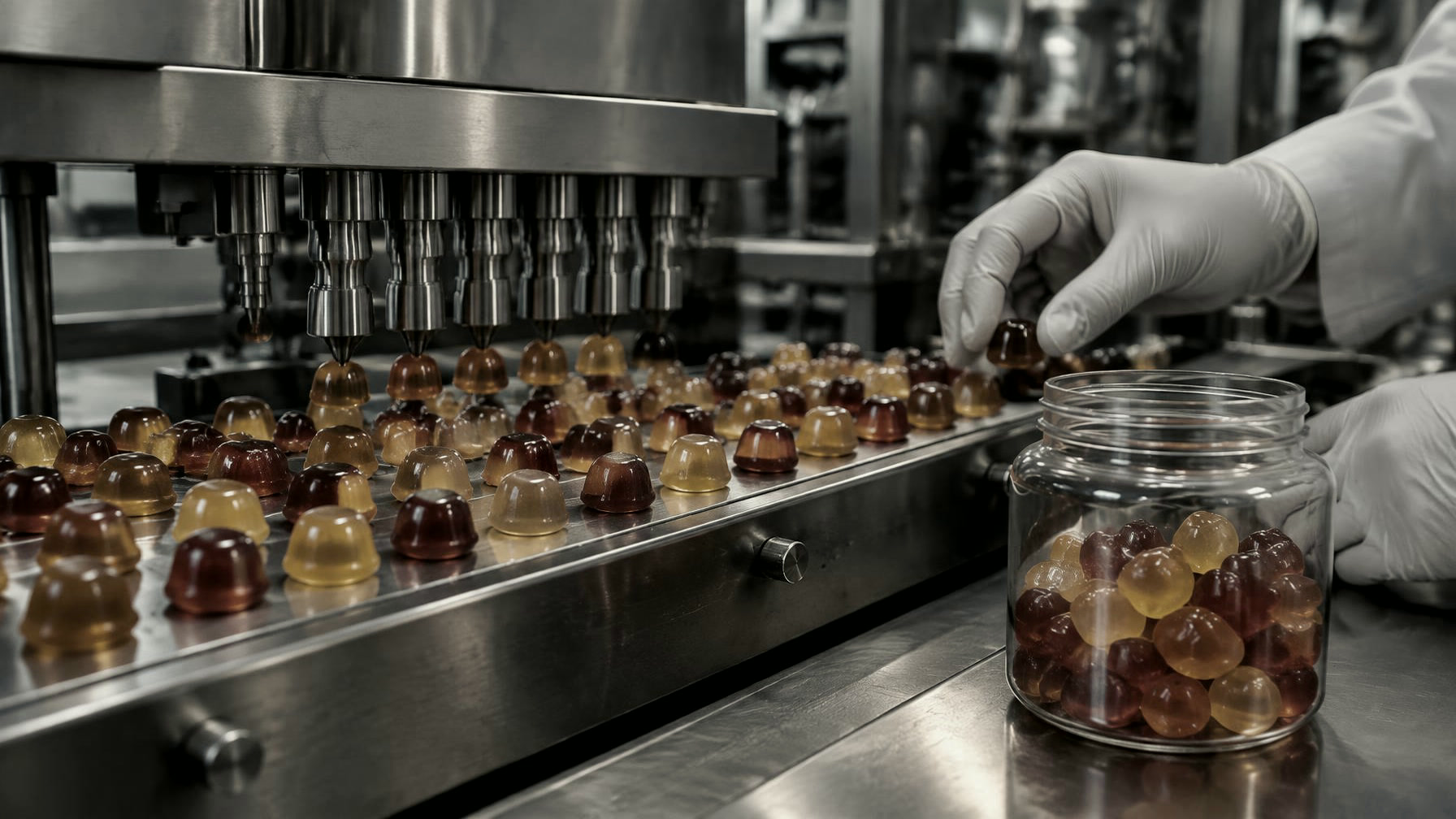
The syrup is deposited into starch moulds or silicone moulds on a depositing line, shaped to the gummy's final form.
Setting and demoulding
Trays are cooled in a conditioning room for several hours to set the gel structure before gummies are demoulded.
Finishing
Gummies are tumbled with a light oil or sugar dusting to reduce stickiness, then inspected for shape and size consistency.
Jar filling
Gummies are filled into jars with a desiccant sachet (if needed) and sealed on a jar-filling and capping line.
What drives the cost
depends
Gelling agent choice
Pectin-based vegetarian gummies often cost a bit more than gelatin-based ones but widen the market the product can be sold in.
raises cost
Active-ingredient loading
Higher doses of vitamins, minerals or botanical extracts per gummy raise ingredient cost and may need taste-masking adjustments.
raises cost
Mould complexity
Custom shapes or dual-layer gummies need dedicated mould tooling, which adds a one-time cost.
raises cost
Humidity control in packing
Gummies are hygroscopic, so humidity-controlled packing rooms and desiccant sachets add to cost but protect shelf life.
lowers cost
Batch size
Larger cook batches reduce the per-unit cost of syrup cooking and depositing changeovers.
Common mistakes first-time brands make
Underestimating humidity sensitivity
Gummies left in a humid packing area can turn sticky or misshapen; always confirm the plant has humidity control at the depositing and packing stage.
Ignoring active-ingredient heat stability
Some vitamins degrade if dosed into syrup that's too hot; ask how the manufacturer handles heat-sensitive actives.
Assuming gelatin and pectin gummies behave the same
Pectin sets differently from gelatin and needs its own process tuning; a line optimised for one may need real adjustment time for the other.
Not budgeting for mould tooling
Custom-shaped gummies need dedicated moulds that are a one-time cost separate from the per-unit price; confirm this upfront.
Choosing a manufacturer for nutraceutical gummies
Capabilities
Check whether the manufacturer runs a starch-mogul line for high volumes or a mould-depositing line better suited to smaller, custom-shape runs.
Certifications
FSSAI licence is mandatory; GMP certification is worth prioritising given active-ingredient dosing accuracy matters here.
Capacity
Confirm daily depositing capacity against your SKU count, since multi-flavour launches multiply changeover time.
Sampling
Request a small trial batch to check texture, active-ingredient uniformity and stickiness before full production.
Frequently asked questions
- Can gummies be made vegetarian?
- Yes, pectin-based gummies replace gelatin for a vegetarian formulation, though the syrup-cooking parameters need adjusting for pectin's different set behaviour.
- How much does active-ingredient loading affect cost?
- Higher doses of vitamins or botanical extracts raise ingredient cost directly and can also need taste-masking, which adds further to the per-unit price.
- Why do gummies need a desiccant in the jar?
- Gummies are hygroscopic and can absorb moisture from the air, so a desiccant sachet helps protect texture and shelf life inside a sealed jar.
- What is the minimum order for a gummy SKU?
- Most manufacturers set MOQ around 5,000–10,000 jars (30-count), tied to the minimum syrup-cook batch size.
- How long does a custom gummy shape take to set up?
- Custom moulds typically add 2–3 weeks to the standard lead time for tooling fabrication before production can start.
How BrandForge helps
BrandForge takes your gummy brief — gelling agent, active dose and shape — and matches it double-blind to manufacturers verified for depositing-line capability and active-ingredient dosing accuracy. A success manager stays involved from the trial batch through to the humidity-controlled packing run once both sides approve the match.