Manufacturing guide · Personal care
Lip balm contract manufacturing in India
Lip balm MOQs typically run 5,000–10,000 units, and a 4–5 g stick costs roughly ₹15–40 ex-factory. First batches ship in 8–12 weeks, and the manufacturer needs a cosmetics manufacturing licence issued by the State Licensing Authority under the Cosmetics Rules, 2020.
Key facts
| Typical MOQ | 5,000–10,000 units per SKU |
|---|---|
| Typical pack sizes | 4–5 g twist-up stick, 10 g tin/pot |
| Indicative cost per unit | ₹15–40 for a 4–5 g twist-up stick |
| What the cost covers | Ex-factory: wax-oil base, actives, tube component and filling included; excludes GST, freight, shipper cartons, brand margin |
| Lead time, brief to first batch | 8–12 weeks, brief to first batch |
| Key licences and certifications | Cosmetics manufacturing licence issued by the State Licensing Authority under the Cosmetics Rules, 2020; Legal Metrology labelling for pre-packaged goods |
| Typical shelf life | 24–30 months unopened |
| Common formats | Twist-up tube stick, tin/pot balm, tinted stick variant |
How it is made
Wax and oil melting
Beeswax or candelilla wax is melted with carrier oils and butters in a heated jacketed vessel to form the balm base.
Active and fragrance addition
Actives, flavour or fragrance, and any tint pigment are stirred in once the melt cools slightly, to avoid degrading heat-sensitive components.
Mould or tube filling at pour temperature
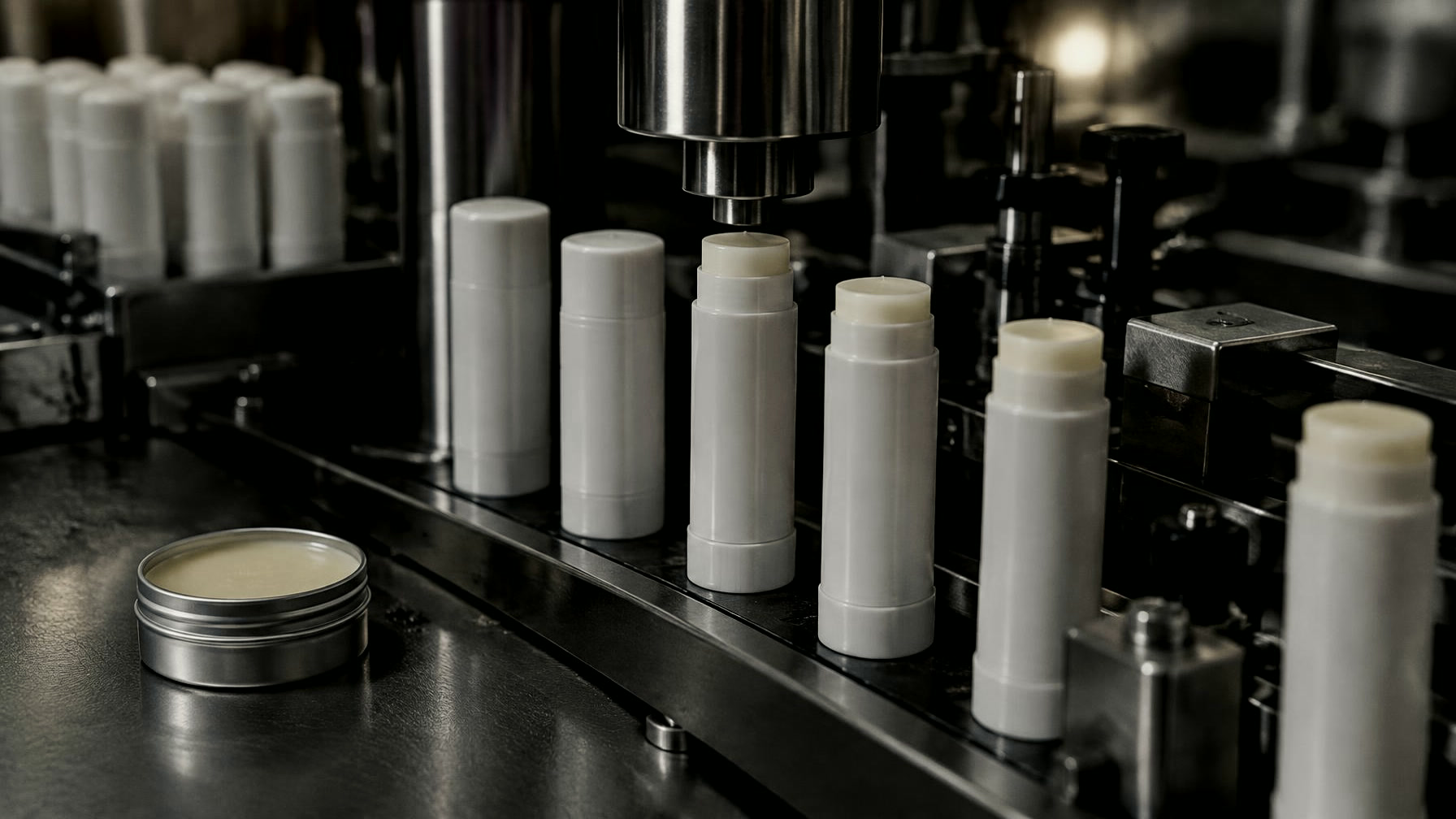
The molten balm is poured into tube moulds or directly into open tubes at a precise temperature window, since pouring too hot or too cool causes surface defects.
Cooling and setting
Filled tubes are cooled under controlled conditions to set the wax structure and avoid sink marks or a dull surface.
Capping and batch coding
Tubes are capped, bottom-stamped with batch code, and packed into trays and shippers.
What drives the cost
depends
Wax type (beeswax vs vegetable wax)
Beeswax and candelilla/carnauba vegetable waxes price differently and swing with seasonal availability, affecting base cost.
raises cost
Tinted or flavoured variants
Adding pigment dispersion or flavour oil raises formulation cost and needs extra colour-consistency checks between batches.
raises cost
Tube component quality
Premium twist-up tube mechanisms cost more than basic ones and affect perceived product quality.
depends
Pour temperature control
Tighter pour-temperature control reduces surface defects but can slow the filling line, affecting cost per unit at small batch sizes.
lowers cost
Batch size
Larger wax-melt batches reduce the proportion of melting and cleaning time charged to each stick.
Common mistakes first-time brands make
Pouring at the wrong temperature
Pouring too hot causes sink marks as the balm cools; pouring too cool causes an uneven, grainy surface — both are quality complaints that show up after the fact.
Ignoring wax-oil ratio drift
Small changes in ambient temperature during storage can affect a balm's firmness if the wax-oil ratio isn't buffered for the target climate.
Underestimating tint batch consistency
Tinted balms need colour-matching checks between batches, which brands sometimes skip, leading to visible shade variation across stock.
Choosing a manufacturer for lip balm
Wax-based formulation experience
Check the manufacturer's experience with wax-oil balm systems specifically, not just liquid cosmetic formulations.
Certifications
Look for cosmetic manufacturing licence, GMP, or AYUSH licence if going the ayurvedic balm route.
Capacity for small-stick filling
Confirm the line can handle precise small-volume pours into tube moulds at your required speed.
Sampling process
Ask for a small pilot pour run to check surface finish and firmness before locking the full batch.
Frequently asked questions
- Can lip balm be positioned as ayurvedic?
- Yes, but it then needs manufacture under an AYUSH licence rather than a standard cosmetic licence, so confirm positioning before choosing a manufacturer.
- Why do some lip balm sticks look dull on top?
- A dull or sunken top usually means the balm was poured or cooled outside the ideal temperature window; manufacturers control this closely to avoid it.
- Can I add SPF to a lip balm?
- Yes, SPF lip balms are possible but need UV filter compatibility testing with the wax base and may extend lead time similar to sunscreen testing.
- What's the minimum order for a tinted variant range?
- Each tint shade typically needs its own MOQ of 5,000–10,000 units since pigment dispersion and colour-matching are done per shade.
How BrandForge helps
BrandForge matches your lip balm brief double-blind against manufacturers experienced in wax-based pour filling, revealing names only once both sides approve. A success manager then helps track the pilot pour run for surface finish before full production.