Manufacturing guide · Personal care
Face serum contract manufacturing in India
Face serum MOQs typically run 3,000–10,000 units, and a 30 ml glass dropper bottle costs roughly ₹60–150 ex-factory depending on the active concentration. First batches ship in 8–14 weeks, and the manufacturer needs a cosmetics manufacturing licence issued by the State Licensing Authority under the Cosmetics Rules, 2020.
Key facts
| Typical MOQ | 3,000–10,000 units per SKU |
|---|---|
| Typical pack sizes | 15 ml, 30 ml, 50 ml glass dropper bottle |
| Indicative cost per unit | ₹60–150 for a 30 ml glass dropper bottle |
| What the cost covers | Ex-factory: active ingredients, base, glass dropper bottle and filling included; excludes GST, freight, shipper cartons, brand margin |
| Lead time, brief to first batch | 8–14 weeks, brief to first batch |
| Key licences and certifications | Cosmetics manufacturing licence issued by the State Licensing Authority under the Cosmetics Rules, 2020; Legal Metrology labelling for pre-packaged goods |
| Typical shelf life | 18–24 months unopened |
| Common formats | Amber or clear glass dropper bottle, airless pump as an alternative |
How it is made
Active sourcing and weighing
Actives such as vitamin C derivatives, niacinamide or hyaluronic acid are weighed against a certificate of analysis before batching.
Low-heat or cold mixing
Water- and oil-phase ingredients are mixed at controlled temperature, often cold-processed to protect heat-sensitive actives.
Filtration and degassing
The batch is filtered to remove particulates and degassed before filling, since serums are judged on clarity.
Dropper bottle filling
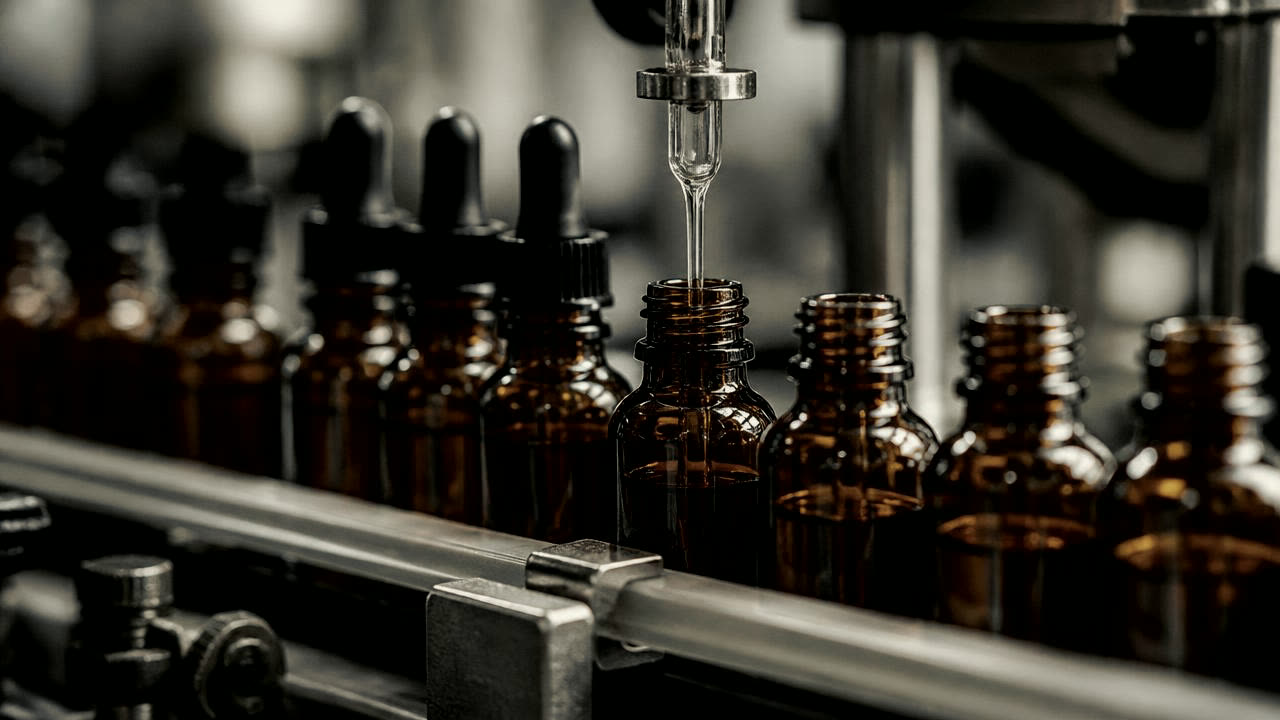
Glass bottles are filled by volumetric or peristaltic pump filler to a tight fill-volume tolerance, then dropper assemblies are crimped on.
Batch coding and boxing
Each bottle is batch-coded, placed in a mono-carton with insert, and packed into shippers.
What drives the cost
raises cost
Active ingredient concentration
Higher percentages of actives like vitamin C or peptides directly raise the per-ml formulation cost.
raises cost
Glass bottle and dropper assembly
Glass bottles with calibrated droppers cost more than plastic bottles and need careful handling during filling.
depends
Preservative system
Preservative-free or minimal-preservative formulations need tighter manufacturing hygiene, which can raise cost.
lowers cost
Batch size
Running a larger batch amortises active-ingredient sourcing and QC testing cost over more units.
raises cost
Fill-volume tolerance
Serums sold by precise ml count need tighter fill-accuracy checks than bulk-filled products, adding inspection time.
Common mistakes first-time brands make
Ignoring active stability
Some actives like vitamin C degrade with light and air exposure; skipping accelerated stability testing risks discolouration on shelf.
Choosing the wrong dropper gauge
A dropper that dispenses too much or too little per drop frustrates users and can be flagged late if not tested early.
Underestimating filtration time
Thicker serum bases take longer to filter and degas; rushing this step leaves visible particulates.
Choosing a manufacturer for face serum
Active-ingredient sourcing capability
Confirm the manufacturer sources actives with valid certificates of analysis from traceable suppliers.
Certifications
Look for cosmetic manufacturing licence and ISO 22716 cosmetic GMP certification.
Capacity for small-batch glass filling
Serum lines run slower than bulk lotion lines; confirm the filler can handle glass dropper bottles at your volume.
Sampling process
Request a bench sample and a stability pull-sample schedule before locking the full batch.
Frequently asked questions
- Can I combine multiple actives in one serum?
- Yes, but some active combinations (such as vitamin C with certain exfoliants) need formulation adjustments to remain stable together.
- Is an airless pump better than a dropper?
- An airless pump reduces air and light exposure for sensitive actives, though it costs more than a standard dropper bottle.
- How is fill accuracy checked?
- Random bottles are weighed against target fill weight during the run, with tolerance bands agreed before production starts.
- Do I need separate testing for each active?
- Each new active typically needs its own compatibility and stability check within the base formulation, which can add to development time.
How BrandForge helps
BrandForge matches your serum brief double-blind against formulators experienced with your specific actives, revealing identities only once both sides approve. Your success manager then coordinates stability sign-off before the full batch is released.