Manufacturing guide · Personal care
Roll-on deodorant contract manufacturing in India
Roll-on deodorant MOQs typically run 3,000–10,000 units, and a 50 ml bottle costs roughly ₹30–65 ex-factory. First batches ship in 8–14 weeks, and the manufacturer needs a cosmetics manufacturing licence issued by the State Licensing Authority under the Cosmetics Rules, 2020.
Key facts
| Typical MOQ | 3,000–10,000 units per SKU |
|---|---|
| Typical pack sizes | 50 ml, 65 ml roll-on bottle |
| Indicative cost per unit | ₹30–65 for a 50 ml roll-on bottle |
| What the cost covers | Ex-factory: active/fragrance base, PET bottle, ball applicator and filling included; excludes GST, freight, shipper cartons, brand margin |
| Lead time, brief to first batch | 8–14 weeks, brief to first batch |
| Key licences and certifications | Cosmetics manufacturing licence issued by the State Licensing Authority under the Cosmetics Rules, 2020; Legal Metrology labelling for pre-packaged goods |
| Typical shelf life | 24–30 months unopened |
| Common formats | Roll-on bottle with ball applicator, stick format as an alternative |
How it is made
Base formulation
An aqueous or alcohol-based carrier is blended with odour-control actives, fragrance and emollients under controlled mixing.
Clarity and viscosity check
The batch is checked for clarity (critical for roll-on formats, since any haze is visible through the bottle) and viscosity before filling.
Ball applicator fitting
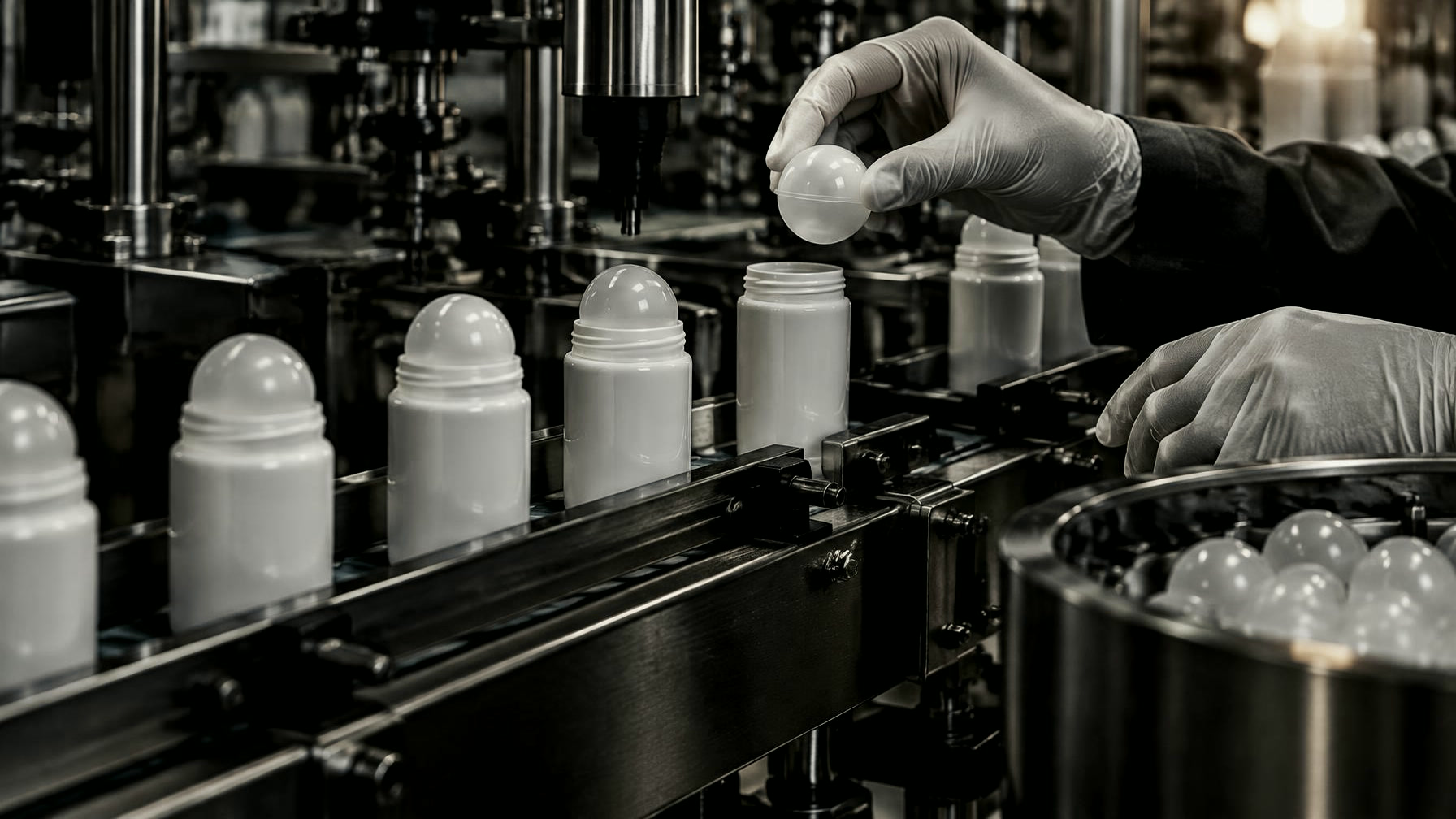
Roll-on balls are press-fitted into the bottle neck on a dedicated assembly station, a step unique to this format versus spray or stick deodorants.
Bottle filling
Liquid is filled by volumetric filler before the ball-and-cap assembly is seated, then each unit is leak-tested on a steel conveyor.
Labelling and cartoning
Labels, batch code and MRP are applied, and bottles are packed into shippers.
What drives the cost
raises cost
Odour-control active package
Higher concentrations of odour-control actives raise raw-material cost per ml compared with a basic fragrance-only formulation.
raises cost
Ball applicator quality
A smoother-rolling, leak-resistant ball mechanism costs more per unit than a basic stamped ball.
raises cost
Clarity requirement
A fully clear, haze-free formulation needs tighter ingredient-grade control than an opaque or lotion-style roll-on.
depends
Fragrance load
Fragrance concentration and type are one of the larger swing costs in the overall formulation.
lowers cost
Batch size
Larger batches spread mixing and QC time over more bottles, lowering per-unit cost.
Common mistakes first-time brands make
Ignoring ball-fit tolerance
A poorly fitted ball applicator leaks during transit or dispenses unevenly; this needs to be checked on the actual bottle-ball combination, not a generic sample.
Skipping clarity stability checks
A roll-on that looks clear at filling can haze over weeks if the formulation isn't temperature-stable; accelerated stability testing catches this early.
Underestimating leak testing
Roll-on bottles are more prone to transit leakage than spray or stick formats, so each unit typically needs individual leak testing before cartoning.
Choosing a manufacturer for roll-on deodorant
Roll-on-specific formulation experience
Check the manufacturer's track record with roll-on clarity and ball-fit assembly specifically, since this differs from spray deodorant lines.
Certifications
Look for cosmetic manufacturing licence, GMP and ISO 22716 certification.
Ball-fitting and leak-test capacity
Confirm the line has a dedicated ball-assembly station and individual leak-testing step.
Sampling process
Request a bench sample and a small pilot run to check ball-fit and leak performance before full MOQ.
Frequently asked questions
- Why do roll-on deodorants need a clarity check?
- Any haze or particulate is visible through the bottle in a roll-on format, so manufacturers run a dedicated clarity check that isn't as critical for opaque formats.
- Can I switch from spray to roll-on with the same formulation?
- Not directly; a roll-on needs its own viscosity and clarity profile, so the formulation typically needs rework rather than a straight carry-over.
- How is leak-proofing tested?
- Filled units are inverted and checked over a hold period, often alongside a transit-simulation shake test, before the batch is cleared for shipment.
- What ball applicator sizes are available?
- Standard ball sizes fit most stock roll-on bottle necks; a custom ball size would need its own tooling and a higher MOQ.
How BrandForge helps
BrandForge matches your roll-on deodorant brief double-blind against manufacturers experienced in ball-fit assembly and clarity formulation, revealing names only once both sides approve. A success manager then tracks the pilot run's leak-test results before full production.