Manufacturing guide · Personal care
Shampoo contract manufacturing in India
Shampoo brands typically start with an MOQ of 3,000–10,000 bottles and a 200 ml PET bottle costs roughly ₹35–75 ex-factory. First batch usually ships in 8–14 weeks from a finalised brief, and the manufacturer needs a cosmetics manufacturing licence issued by the State Licensing Authority under the Cosmetics Rules, 2020.
Key facts
| Typical MOQ | 3,000–10,000 units per SKU |
|---|---|
| Typical pack sizes | 100 ml, 200 ml, 340 ml, 650 ml refill pouch |
| Indicative cost per unit | ₹35–75 for a 200 ml PET bottle |
| What the cost covers | Ex-factory: surfactant base, actives, fragrance, PET bottle, flip-top cap and filling included; excludes GST, freight, shipper cartons, brand margin |
| Lead time, brief to first batch | 8–14 weeks, brief to first batch |
| Key licences and certifications | Cosmetics manufacturing licence issued by the State Licensing Authority under the Cosmetics Rules, 2020; Legal Metrology labelling for pre-packaged goods |
| Typical shelf life | 24–36 months unopened |
| Common formats | Clear or opaque PET bottle, flip-top cap, sachet for trial sizes |
How it is made
Base formulation
Surfactant blend (typically sulphate or sulphate-free system) is mixed with thickeners, conditioning agents and preservatives in a jacketed mixing vessel under controlled pH.
Viscosity and pH adjustment
Batch is checked for viscosity, pH and clarity; salt or thickener is dosed to hit the target pour consistency before fragrance and colour are added.
Hold and quality check
The batch is held for stability observation and a QC sample is pulled for microbial and physical testing before release to filling.
Bottle filling and capping
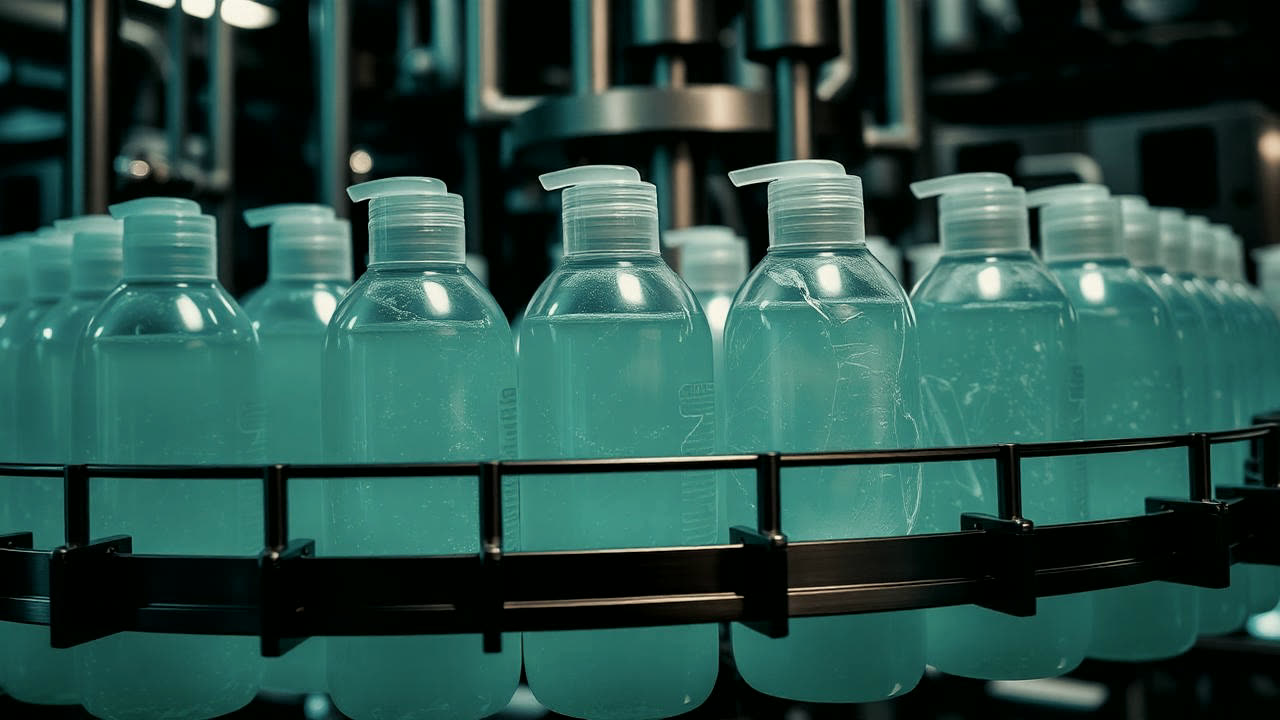
PET bottles move through a rotary volumetric filler, flip-top caps are applied and induction-sealed, then torque-checked.
Labelling and cartoning
Labels are applied, batch code and MRP are printed per Legal Metrology rules, and bottles are packed into shippers.
What drives the cost
raises cost
Surfactant system (sulphate vs sulphate-free)
Sulphate-free and mild surfactant blends cost noticeably more per kg than standard SLES-based systems.
raises cost
Conditioning actives and silicones
Added actives such as keratin, silicone conditioners or botanical extracts raise formulation cost per litre.
raises cost
Bottle and cap tooling
Custom bottle shapes need dedicated moulds; stock bottle shapes keep per-unit packaging cost lower.
lowers cost
Batch size
Larger mixing batches (500 kg+) spread cleaning, labour and QC cost over more litres, lowering per-bottle cost.
depends
Fragrance grade
Fragrance cost varies widely by supplier and dosage; it is one of the larger swing items in a shampoo formulation cost sheet.
Common mistakes first-time brands make
Skipping stability testing
Viscosity and fragrance can drift over weeks; brands that skip accelerated stability testing discover separation or fading only after retail complaints.
Changing fragrance house late
Switching fragrance supplier after formulation lock can shift viscosity and preservation efficacy, forcing a re-trial.
Under-specifying cap torque
Loose flip-top caps lead to transit leakage; torque specification should be agreed and tested before the first production run.
Choosing a manufacturer for shampoo
Formulation capability
Check whether the manufacturer has in-house R&D for surfactant systems or only replicates existing formulations.
Certifications
Look for a valid cosmetic manufacturing licence, GMP and ISO 22716 cosmetic GMP certification.
Filling line capacity
Confirm the rotary filler's bottles-per-minute rate matches your MOQ and reorder cadence.
Sampling process
Ask for a bench sample and then a pilot batch of 200–500 bottles before committing to full MOQ.
Frequently asked questions
- Can I launch a sulphate-free shampoo at this MOQ?
- Yes, most manufacturers can formulate sulphate-free systems at the same MOQ, though the per-unit cost sits toward the higher end of the ₹35–75 band.
- Do I need a dermatologist test certificate?
- It is not mandatory for a standard shampoo launch, but some manufacturers offer optional patch-test documentation as a value add.
- How long does fragrance customisation take?
- Custom fragrance matching typically adds 2–3 weeks to the lead time because it needs its own stability check.
- What packaging formats are available at low MOQ?
- Stock PET bottles in 100 ml and 200 ml are widely available at low MOQ; refill pouches usually need a higher MOQ due to pouch tooling.
How BrandForge helps
BrandForge matches your shampoo brief double-blind against verified formulators by surfactant system and bottle format, revealing names only after both sides approve. A success manager then helps you track the pilot batch through to full production.