Manufacturing guide · Nutraceuticals
Stick packs and sachets contract manufacturing in India
Powder stick packs and sachets are contract manufactured on form-fill-seal lines, typically at an MOQ of 300–1,000 kg of blend (roughly 30,000–1 lac sachets at a 10 g fill, before losses), costing about ₹4–12 per 10 g sachet ex-factory depending on fill weight and laminate. First batch generally ships in 8–14 weeks under an FSSAI licence.
Key facts
| Typical MOQ | 300–1,000 kg finished blend (roughly 30,000–1 lac sachets of 10 g before losses; counts vary with fill weight) |
|---|---|
| Typical pack sizes | 5 g, 10 g and 15 g single-serve sachets or stick packs |
| Indicative cost per unit | ₹4–12 per 10 g sachet (ex-factory) |
| What the cost covers | Ex-factory: powder blend, laminate pouch material, form-fill-seal conversion and secondary carton included; excludes GST, freight, brand margin |
| Lead time, brief to first batch | 8–14 weeks from brief and blend trial to first form-fill-seal batch |
| Key licences and certifications | FSSAI licence; product must comply with the FSS (Health Supplements, Nutraceuticals, Food for Special Dietary Use, Food for Special Medical Purpose, Functional Food and Novel Food) Regulations; Legal Metrology labelling for pre-packaged goods |
| Typical shelf life | 12–18 months from manufacture, dependent on laminate barrier |
| Common formats | Powder only; vertical form-fill-seal (VFFS) stick pack or flat sachet |
How it is made
Formulation and flow testing
Actives, fillers and flow agents are blended and checked for flowability, since poor flow causes weight variation on a high-speed filling line.
Blending and dust control
A ribbon blender mixes the powder batch under dust-controlled conditions, important when fine particles or flavour powders are involved.
Laminate selection
A multi-layer laminate (typically PET/aluminium/PE or a mono-material PE alternative) is chosen for moisture and aroma barrier based on the actives' sensitivity.
Form-fill-seal filling
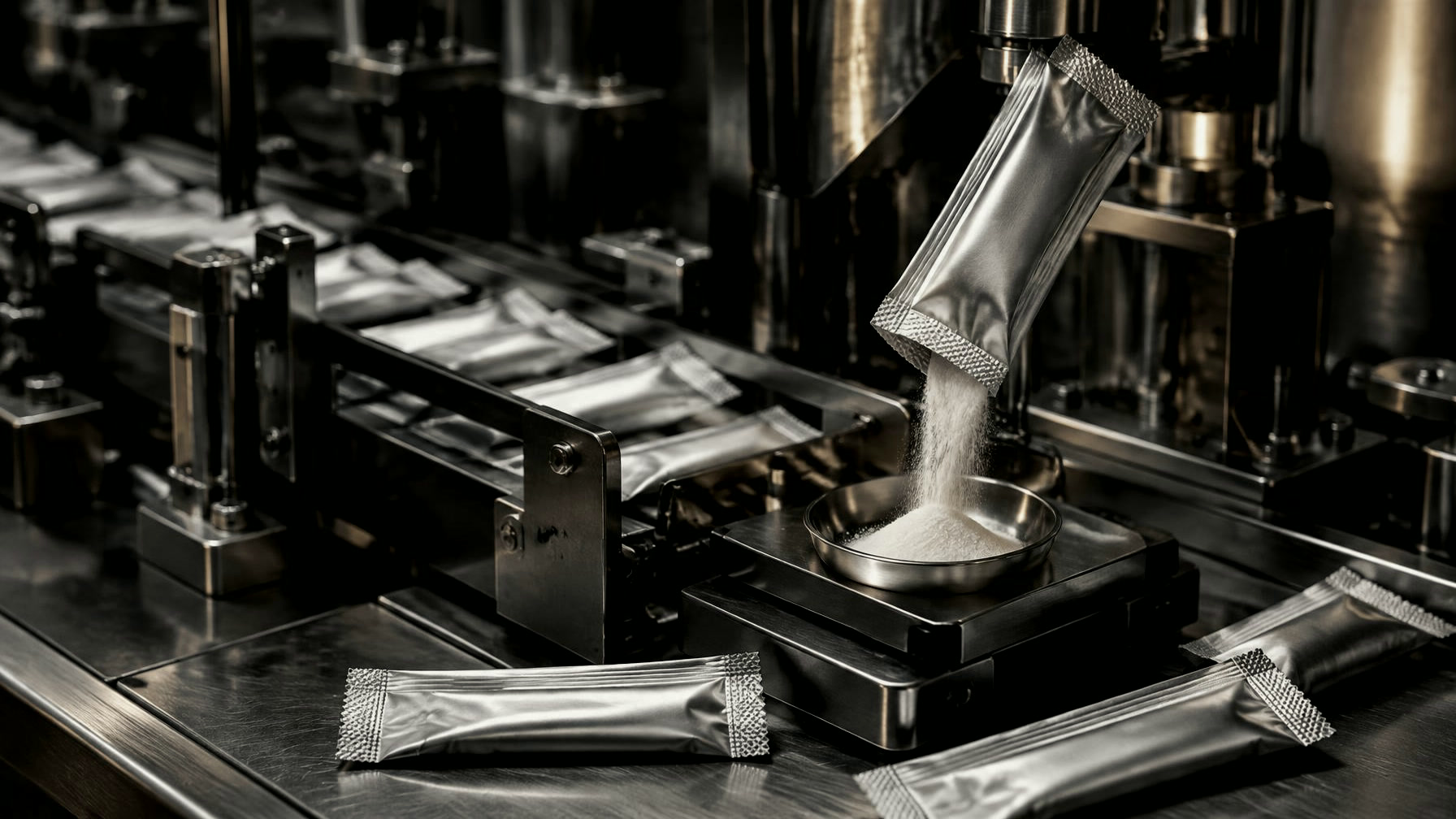
A vertical form-fill-seal machine forms the sachet from a laminate roll, doses powder by auger or volumetric cup, and seals and cuts each stick in one continuous run.
Weight checking and metal detection
In-line checkweighers flag underfilled sachets and a metal detector screens the sealed sticks before they are cartoned.
Cartoning and batch release
Sticks are counted into secondary cartons, and a sample from the run is tested for fill weight accuracy and seal strength before dispatch.
What drives the cost
raises cost
Laminate structure
A foil-based laminate with a stronger moisture barrier costs more per sachet than a simpler PE-based structure.
raises cost
Fill weight
A 15 g sachet naturally costs more in blend per unit than a 5 g sachet, even though conversion cost per sachet stays similar.
lowers cost
Line speed and batch size
Running a full blend batch continuously on a high-speed FFS line brings down the per-sachet conversion cost.
raises cost
Flavour and solubility agents
Added flavour masking or solubility enhancers for powders that clump in water raise the blend cost per kg.
raises cost
Print and artwork complexity
Multi-colour rotogravure printing on the laminate roll costs more in plate and ink charges than a simple two-colour print.
raises cost
Seal strength rework
Sachets failing seal-strength checks are rejected and must be re-run, which is more noticeable on short trial batches.
Common mistakes first-time brands make
Underestimating powder flowability needs
A blend that cakes or doesn't flow evenly through the FFS auger causes inconsistent fill weight and line stoppages.
Choosing a thin laminate for a hygroscopic blend
Brands sometimes pick a cheaper laminate without checking moisture-vapour transmission rate, shortening shelf life for moisture-sensitive actives.
Not testing solubility before scale-up
A powder that doesn't dissolve cleanly in water at trial scale often shows the same problem at commercial scale; this should be tested early.
Overlooking seal-strength variation at high line speed
Running a line faster than the laminate and sealing-jaw temperature can handle increases weak-seal rejects later in distribution.
Choosing a manufacturer for stick packs and sachets
FFS line capability
Confirm the manufacturer's form-fill-seal line handles your target fill weight and laminate type at commercial speed, not just on a pilot line.
Certifications
FSSAI licence is the baseline; GMP or ISO 22000 certification indicates documented control over fill-weight accuracy and seal integrity.
Capacity fit
Match your 300–1,000 kg blend MOQ against their minimum FFS run length, since very short runs can mean higher changeover cost per kg.
Sampling for seal and solubility
Ask for a pilot batch with seal-strength data and a solubility check in water before committing to full production.
Frequently asked questions
- What is the MOQ for stick packs and sachets?
- Most manufacturers quote MOQ by blend batch weight, typically 300–1,000 kg, which works out to roughly 30,000–1 lac sachets at 10 g before filling losses.
- What laminate should I choose for my powder?
- A foil-based laminate suits moisture- or oxygen-sensitive actives, while a simpler PE-based laminate can work for stable, low-sensitivity blends and lowers per-sachet cost.
- How long does a stick pack project take from brief to delivery?
- Expect 8–14 weeks, covering flow and solubility trials, laminate and artwork finalisation, and the commercial FFS run.
- What licence is needed for sachet nutraceuticals?
- An FSSAI licence under the food supplement category is required; GMP certification is commonly requested by retail buyers.
- Can I run small flavour variants within one order?
- Yes, but each flavour typically needs its own short FFS run and changeover, which raises the effective per-sachet cost on small variant quantities.
How BrandForge helps
BrandForge matches your sachet brief against verified form-fill-seal manufacturers, screening on laminate capability and fill-weight accuracy for your specific powder, and reveals names only after both sides approve. A success manager stays involved from the solubility trial through to the first cartoned batch.