Manufacturing guide · Nutraceuticals
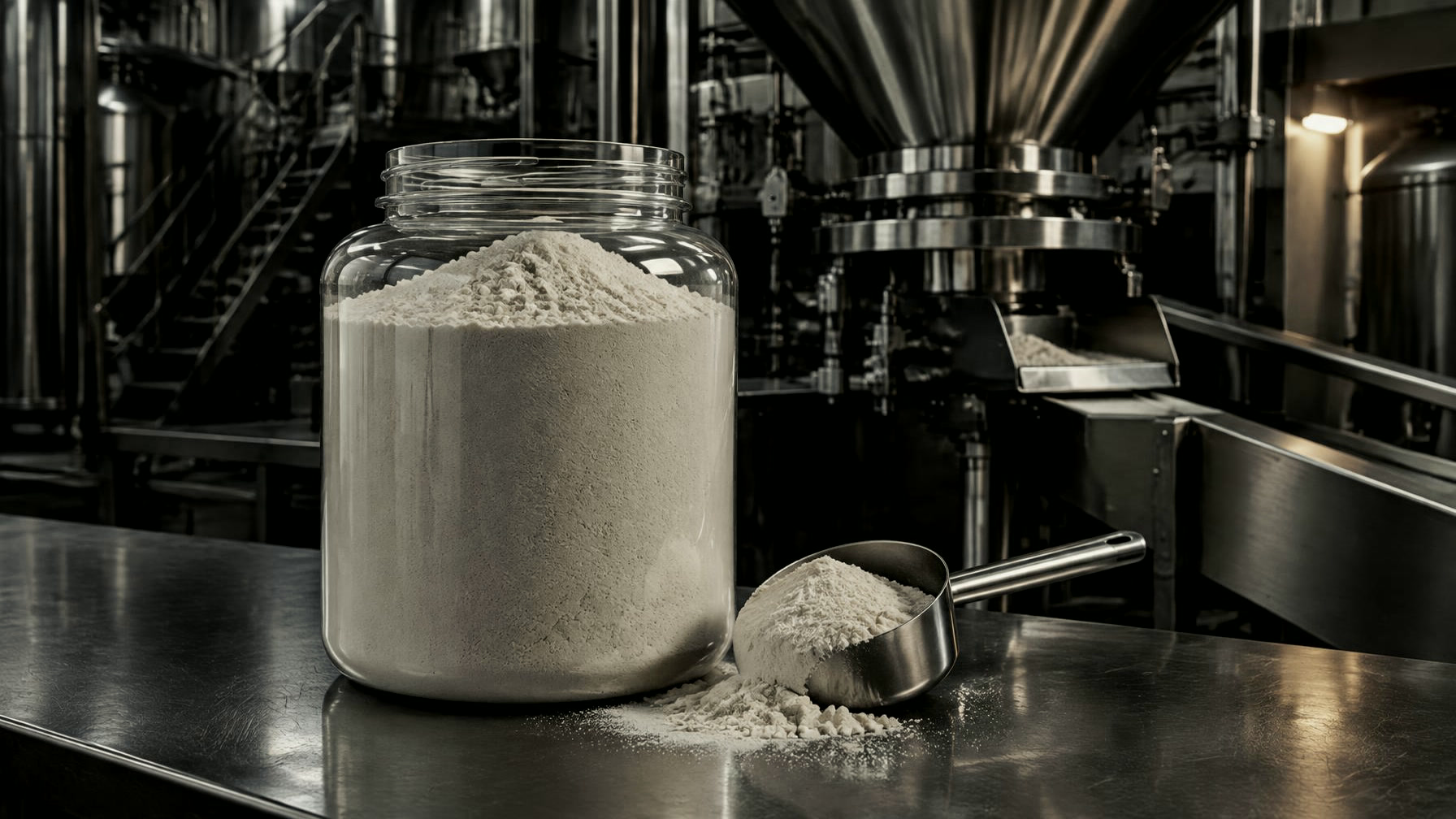
Whey protein powder contract manufacturing in India
Whey protein powder is typically contract manufactured at a 300–1,000 kg finished-blend batch MOQ (roughly 300–1,000 jars of 1 kg before filling losses), costing ₹1,000–1,700 ex-factory for a concentrate-led 1 kg jar depending on protein fraction and flavour system; isolate-rich blends need a separate quote. First batch usually takes 8–14 weeks from a signed brief, and the unit must hold an FSSAI licence with a dedicated blending and packing line.
Key facts
| Typical MOQ | 300–1,000 kg finished blend (approximately 300–1,000 jars of 1 kg before filling losses) |
|---|---|
| Typical pack sizes | 1 kg, 2 kg and 5 kg jars or pouches; 30 g single-serve sachets for trial packs |
| Indicative cost per unit | ₹1,000–1,700 ex-factory for a concentrate-led 1 kg jar; isolate-rich blends quoted separately |
| What the cost covers | Ex-factory: whey concentrate/isolate, flavour and sweetener system, anti-caking agents, jar/pouch and scoop, blending and filling included; excludes GST, freight, outer shippers, brand margin |
| Lead time, brief to first batch | 8–14 weeks from brief to first batch (longer if a custom flavour needs panel trials) |
| Key licences and certifications | FSSAI licence; product must comply with the FSS (Health Supplements, Nutraceuticals, Food for Special Dietary Use, Food for Special Medical Purpose, Functional Food and Novel Food) Regulations; Legal Metrology labelling for pre-packaged goods |
| Typical shelf life | 12–18 months from manufacture, sealed in a moisture-barrier jar or pouch |
| Common formats | Concentrate (WPC), isolate (WPI) or blended concentrate-isolate; flavoured or unflavoured |
How it is made
Raw whey sourcing and testing
WPC/WPI is sourced in drums from a dairy processor and tested for protein %, moisture and microbial load before it is released to the blending floor.
Dry blending
Protein base, flavour, sweetener, lecithin (for mixability) and anti-caking agents are ribbon- or paddle-blended in defined batch weights to a target homogeneity.
In-process sampling
Samples are pulled mid-batch and at the end to check flow, clumping and flavour uniformity before filling starts.
Filling and sealing
Powder is auger-filled into jars or pouches under low-humidity conditions, with a scoop added and an induction seal applied to protect against moisture ingress.
Labelling and cartoning
Batch-coded labels with nutritional panel and Legal Metrology declarations are applied, then jars are cartoned for dispatch.
Lab release
A certificate of analysis covering protein content, heavy metals and microbiology is issued before the batch ships.
What drives the cost
raises cost
Protein fraction (concentrate vs isolate)
Isolate costs noticeably more per kg than concentrate because of the extra filtration the dairy processor runs.
raises cost
Flavour and masking system
Complex flavour-masking blends for isolate or plant-dairy hybrids add formulation and trial cost.
lowers cost
Batch size
Larger blend batches spread cleaning, changeover and testing cost over more jars.
depends
Jar vs pouch packaging
Jars cost more per unit than stand-up pouches but offer better scoop convenience and shelf presence.
raises cost
Third-party heavy-metal and micro testing
External lab testing for each batch adds a per-batch fee that is worth budgeting separately from ingredient cost.
Common mistakes first-time brands make
Underestimating moisture control needs
Powder blending without humidity control leads to clumping and short shelf life; ask whether the filling room is humidity-managed.
Skipping mixability testing
A flavour and sweetener system that looks fine on paper can clump or foam badly when actually mixed in water or milk; always request a mixability sample before committing to full production.
Ignoring protein-source documentation
Buyers sometimes assume a stated protein % is verified; always ask for the raw-material COA alongside the finished-product COA.
Choosing a manufacturer for whey protein powder
Blending capability
Confirm the unit runs ribbon or paddle blenders sized for your batch volume, not just a generic mixer meant for smaller runs.
Certifications
Look for FSSAI licence plus GMP or ISO 22000; a dairy-protein line benefits from allergen segregation records.
Capacity
Check the plant's monthly blending capacity in tonnes against your growth plan so repeat orders are not queued behind other brands.
Sampling process
A manufacturer should offer a small trial batch with full COA before committing to the main production run.
Frequently asked questions
- What is the minimum order quantity for whey protein powder?
- Most manufacturers set MOQ by blend batch weight, typically 300–1,000 kg, which works out to roughly 300–1,000 jars of 1 kg before filling losses.
- Can I launch with a custom flavour?
- Yes, but custom flavours usually need one or two trial rounds before scale-up, which can add 2–4 weeks to the lead time.
- Isolate or concentrate — which costs less?
- Concentrate costs less per kg because it needs less filtration; isolate costs more but has a higher protein percentage per scoop.
- What licence does the manufacturer need?
- An FSSAI licence is the baseline requirement; GMP or ISO 22000 certification is a good additional filter for a protein-blending unit.
- How is shelf life protected in a jar?
- Induction sealing, a moisture-barrier jar and anti-caking agents in the blend are the main levers manufacturers use to hold shelf life at 12–18 months.
How BrandForge helps
BrandForge takes your brief on protein fraction, flavour and pack size and matches it double-blind against verified blending units with the right batch-size capability. Manufacturer identities are revealed only after both sides approve the fit, and a success manager helps you move from trial batch to first commercial run.