Manufacturing guide · Personal care
Sunscreen contract manufacturing in India
Sunscreen MOQs typically run 3,000–10,000 units and a 50 g tube costs roughly ₹55–120 ex-factory. Lead time usually runs longer than other personal care products, 10–16 weeks, because SPF testing adds time, and the manufacturer needs a cosmetics manufacturing licence issued by the State Licensing Authority under the Cosmetics Rules, 2020.
Key facts
| Typical MOQ | 3,000–10,000 units per SKU |
|---|---|
| Typical pack sizes | 50 g, 100 g tube; 50 ml, 100 ml pump bottle |
| Indicative cost per unit | ₹55–120 for a 50 g cream tube |
| What the cost covers | Ex-factory: UV filters, emulsion base, tube and crimping included; excludes GST, freight, SPF lab testing fee, brand margin |
| Lead time, brief to first batch | 10–16 weeks, brief to first batch, longer than other personal care categories because of SPF testing |
| Key licences and certifications | Cosmetics manufacturing licence issued by the State Licensing Authority under the Cosmetics Rules, 2020; Legal Metrology labelling for pre-packaged goods |
| Typical shelf life | 24 months unopened |
| Common formats | Laminate or aluminium tube, airless pump bottle for gel formats |
How it is made
UV filter selection
Chemical and/or mineral UV filters (such as octinoxate, avobenzone, zinc oxide) are selected based on the target SPF and formulation type.
Emulsification
Oil and water phases are emulsified under high shear and controlled temperature to disperse UV filters evenly through the cream base.
In-house SPF screening
A preliminary in-vitro SPF check is run before the batch proceeds, to catch filter-loading errors before costly third-party lab testing.
Third-party SPF and water-resistance testing
A lab-certified SPF test (and water-resistance claim test, if claimed) is commissioned, which is the step that extends sunscreen lead time versus other creams.
Tube filling and crimping
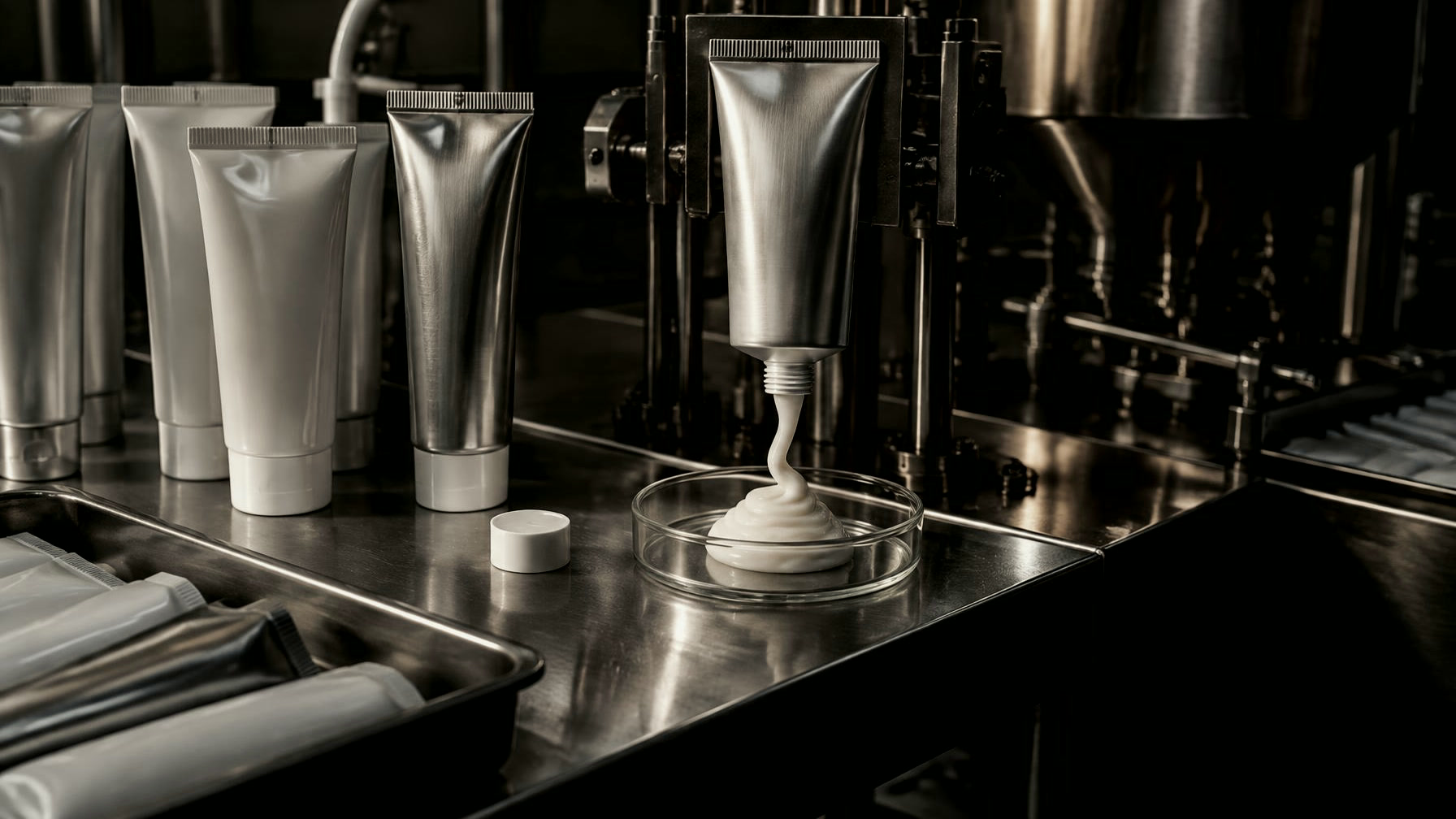
Cream is filled into laminate or aluminium tubes on a filling-crimping line, batch coded, and cartoned.
What drives the cost
raises cost
UV filter type and loading
Higher SPF targets need higher filter loading, and broad-spectrum mineral filters cost more per kg than many chemical filters.
raises cost
Third-party SPF lab testing
Each formulation variant needs its own SPF test, which is a fixed per-batch cost regardless of order size.
raises cost
Water-resistance claim
Claiming water resistance requires an additional test protocol and a formulation that holds up under wet-rub testing.
depends
Tube type (laminate vs aluminium)
Aluminium tubes cost more than laminate but can carry a premium positioning.
lowers cost
Batch size
Running a larger batch spreads the fixed SPF testing cost over more units, lowering cost per tube.
Common mistakes first-time brands make
Skipping the in-house SPF screen
Sending a formulation straight to third-party lab testing without an internal check risks failing the test and paying for a retest.
Underestimating testing lead time
Brands that plan launch dates around standard personal-care lead times often miss them because SPF lab slots and retests take extra weeks.
Choosing a tube incompatible with the formula
Some UV filters can interact with certain tube linings over time; compatibility should be checked during stability testing.
Choosing a manufacturer for sunscreen
SPF formulation track record
Ask for SPF formulations the manufacturer has previously taken through lab testing successfully.
Certifications
Look for cosmetic manufacturing licence, GMP and ISO 22716 certification, plus an established relationship with an SPF testing lab.
Capacity for cream tube filling and crimping
Confirm the filling-crimping line's output rate matches your order size and timeline.
Sampling and testing process
Request a bench sample, in-house SPF screen result, and the third-party lab test report before committing to full MOQ.
Frequently asked questions
- Why does sunscreen take longer to manufacture than other creams?
- Third-party SPF and water-resistance testing adds dedicated lab time that other personal care products don't need, typically pushing lead time to 10–16 weeks.
- Can I claim a specific SPF number without lab testing?
- No, any SPF number claimed on pack needs to be backed by lab test results for that exact formulation and pack.
- Is mineral sunscreen more expensive than chemical sunscreen?
- Mineral UV filters like zinc oxide generally cost more per kg and need higher loading, which raises the ex-factory cost per tube.
- What happens if the SPF test result is lower than targeted?
- The formulation is adjusted (often by increasing filter loading) and retested, which adds time and cost before production can proceed.
How BrandForge helps
BrandForge matches your sunscreen brief double-blind against manufacturers with a track record of passing SPF lab tests on the first attempt, revealing names only after mutual approval. A success manager then tracks the SPF testing timeline so your launch date stays realistic.