Manufacturing guide · Home care
Floor cleaner contract manufacturing in India
Floor cleaner contract manufacturing in India generally runs 5,000–20,000 units at MOQ, with a 1 L bottle costing roughly ₹30–60 depending on fragrance strength and whether the formula is a disinfectant-style or basic surface cleaner. Lead time typically runs 6–10 weeks from approved formulation to first batch. No cosmetic licence applies; the checks that matter are Legal Metrology labelling, awareness of any BIS standards relevant to the specific formulation, and the factory's own state pollution control consent.
Key facts
| Typical MOQ | 5,000–20,000 units (1 L) |
|---|---|
| Typical pack sizes | 500 ml, 1 L, 2 L and 5 L bulk |
| Indicative cost per unit | ₹30–60 per 1 L bottle |
| What the cost covers | Ex-factory: active cleaning agents, fragrance/colour, PET bottle, cap/trigger and filling included; excludes GST, freight, shipper cartons, brand margin |
| Lead time, brief to first batch | 6–10 weeks from approved formulation to first batch |
| Key licences and certifications | General trade and pollution-control approvals for the plant; check whether a mandatory BIS standard applies to your specific product; Legal Metrology labelling for pre-packaged goods |
| Typical shelf life | 18–24 months unopened |
| Common formats | Pour bottle, trigger spray, concentrate for dilution |
How it is made
Active ingredient dosing
Surfactants, solvents and, where formulated, disinfectant actives are dosed into a mixing vessel with water in a fixed sequence, since adding actives out of order can affect clarity or activity.
pH and fragrance adjustment
The batch pH is adjusted to the target range for the floor surfaces it's designed for, then fragrance and colour are blended in once the base has stabilised.
In-process quality checks
Each batch is checked for pH, clarity, fragrance strength and, for concentrates, dilution performance before being cleared for filling.
Bottle filling and trigger/cap fitting
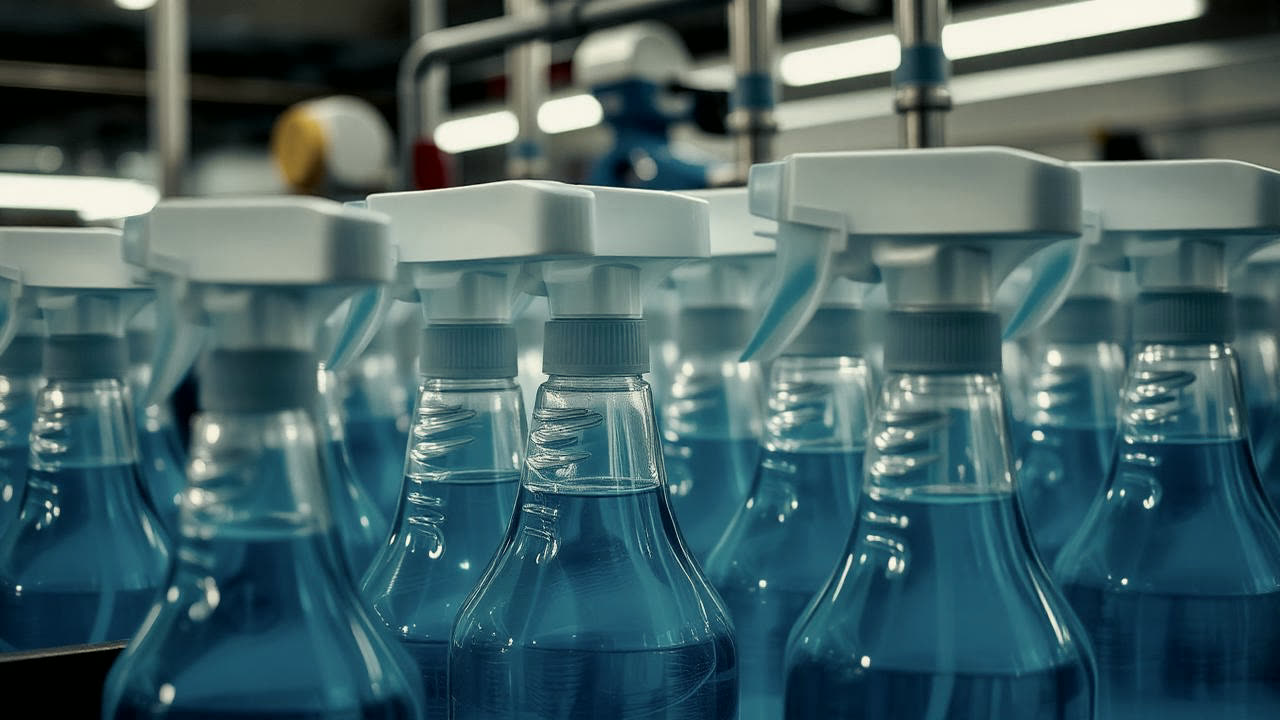
Bottles are filled by volumetric filler and fitted with either a trigger-spray head, flip-top or standard cap depending on the format, then leak-tested.
Labelling, dilution instructions and batch coding
Pack labels carry MRP, net quantity, dilution ratio if applicable, batch code and manufacturer details before cartoning for dispatch.
What drives the cost
raises cost
Disinfectant-style actives
Formulations positioned with stronger antimicrobial-style actives cost more in raw material than a basic surfactant-fragrance floor cleaner.
raises cost
Trigger-spray mechanism
A trigger-spray head costs noticeably more per unit than a simple flip-top or screw cap pour bottle.
lowers cost
Concentrate vs ready-to-use dilution
Concentrated formulations use less water and fewer bottles per batch of active ingredient, lowering packaging cost per use-equivalent, though per-bottle cost looks higher.
raises cost
Fragrance type and strength
Premium or long-lasting fragrance systems add directly to formulation cost at the dosing levels needed for a lingering scent.
lowers cost
Batch and bottle volume
Larger production runs spread vessel cleaning, pH-check and changeover time across more bottles.
Common mistakes first-time brands make
Mislabelling dilution ratios
Concentrate formats need a clear, correctly tested dilution ratio on the pack; getting this wrong leads to either weak performance complaints or wasted product.
Not confirming pollution consent for the specific site
Effluent from floor-cleaner manufacturing needs the site's own state pollution control board consent; a group-level certificate from another facility isn't the same thing.
Choosing trigger sprays without nozzle-clog testing
Thicker or fragrance-heavy formulations can clog spray nozzles over time; ask for a nozzle-performance check before locking the pack format.
Choosing a manufacturer for floor cleaner
Formulation range
Check whether the manufacturer can offer both basic surfactant-based and disinfectant-style floor cleaner formulations to match your positioning.
Relevant standards awareness
Ask whether any BIS standards apply to the specific active system you're using and whether the manufacturer tracks compliance against them.
Filling and capping flexibility
Confirm the line can switch between pour caps and trigger-spray heads without long changeover downtime.
Pilot batch and dilution testing
Request a pilot batch with documented dilution performance data before scaling to bulk MOQ.
Frequently asked questions
- Does floor cleaner need any special licence to manufacture?
- No cosmetic or food licence applies; the main checks are Legal Metrology labelling compliance and the factory's state pollution control board consent, plus any BIS standard relevant to the specific formulation.
- Is a concentrate cheaper to manufacture than a ready-to-use bottle?
- Per-bottle cost for a concentrate can look similar or slightly higher since actives are more concentrated, but it's usually cheaper per use because one bottle makes several diluted batches.
- What causes a trigger spray to clog?
- Thick formulations or fragrance oils that aren't fully solubilised can block the nozzle over time; this is usually caught by pilot-batch nozzle testing before bulk production.
- How do I know if my formulation needs a BIS standard check?
- It depends on the specific active ingredients and claims; it's best to ask your manufacturer directly which standards, if any, apply to your composition.
- Can the same factory make both dishwash liquid and floor cleaner?
- Many home-care manufacturers run both on shared or adjacent lines since the mixing and filling equipment is similar, though dedicated tanks are often used to avoid fragrance cross-contamination.
How BrandForge helps
BrandForge matches your floor cleaner brief against manufacturers with the right formulation and filling-line fit, revealing partner names only after both sides approve. A success manager then supports pilot-batch review and labelling sign-off up to first production.