Manufacturing guide · Home care
Dishwash liquid contract manufacturing in India
Dishwash liquid contract manufacturing in India typically runs 5,000–20,000 units at MOQ, with a 500 ml bottle costing roughly ₹22–45 depending on surfactant system and fragrance load. Lead time is usually 6–10 weeks from approved formulation to first filled batch. There is no cosmetic or food licence requirement here; the main checks are Legal Metrology labelling on the bottle and the factory's own state pollution control consent.
Key facts
| Typical MOQ | 5,000–20,000 units (500 ml) |
|---|---|
| Typical pack sizes | 250 ml, 500 ml, 1 L and 5 L jerry cans/refills |
| Indicative cost per unit | ₹22–45 per 500 ml bottle |
| What the cost covers | Ex-factory: surfactant blend, fragrance/colour, PET bottle, cap and filling included; excludes GST, freight, shipper cartons, brand margin |
| Lead time, brief to first batch | 6–10 weeks from approved formulation to first batch |
| Key licences and certifications | General trade and pollution-control approvals for the plant; check whether a mandatory BIS standard applies to your specific product; Legal Metrology labelling for pre-packaged goods |
| Typical shelf life | 18–24 months unopened |
| Common formats | Clear or tinted liquid, gel and refill pouch |
How it is made
Surfactant blend preparation
Anionic and non-ionic surfactants, builders and thickening salts are mixed in a jacketed vessel with water, with viscosity adjusted by salt dosing until the target thickness is reached.
Fragrance and colour addition
Fragrance and dye are added once the base batch cools to the right temperature, since adding them hot can cause fragrance loss or colour instability.
Clarity and viscosity check
Each batch is checked for clarity (no haze), correct viscosity and foam performance before it is cleared for filling.
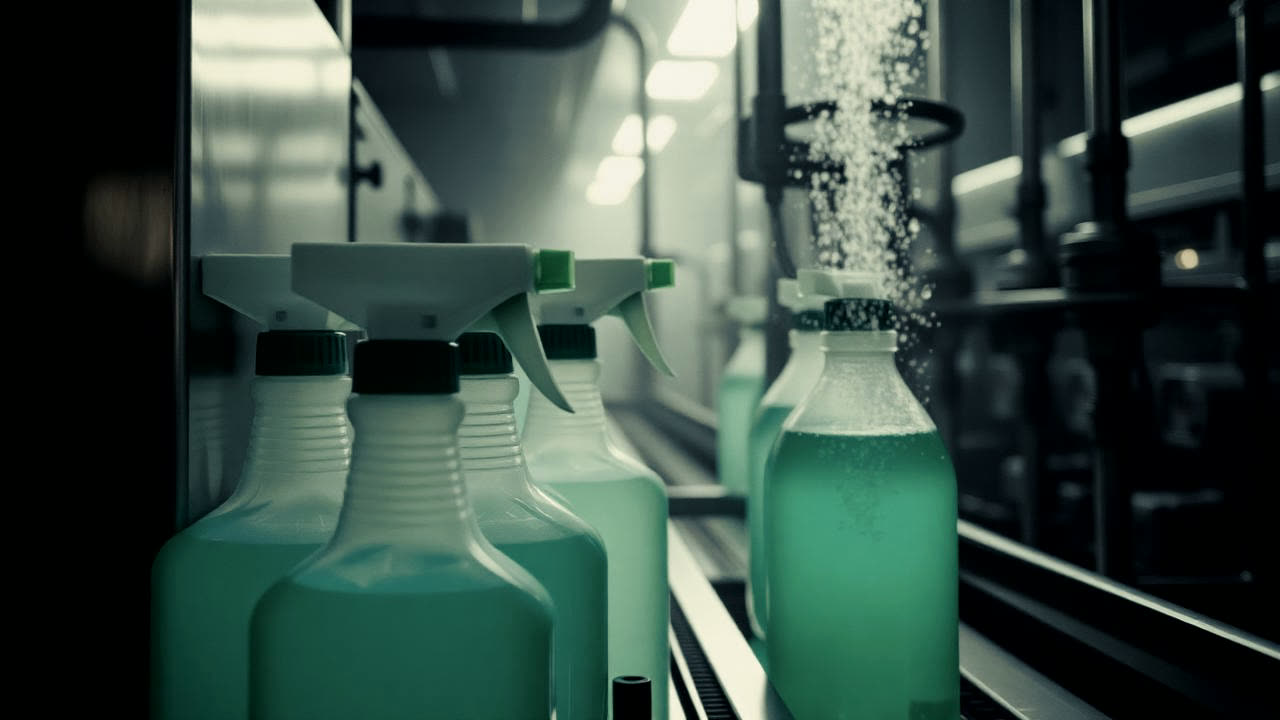
PET bottle filling and capping
Bottles move through a volumetric or level filler, are capped with an induction seal or flip-top, and pass an in-line fill-weight and leak check.
Labelling and batch coding
Bottles are labelled with MRP, net quantity, batch code and manufacturer details as required under Legal Metrology rules, then cartoned for dispatch.
What drives the cost
raises cost
Surfactant system choice
Milder or higher-active surfactant blends cost more per litre than basic linear alkylbenzene sulphonate-heavy formulations.
raises cost
Fragrance intensity
Stronger or branded fragrance houses charge a premium per kg that shows up directly in unit cost at higher dosing.
raises cost
Bottle design and cap type
A sculpted or custom PET bottle and a flip-top dispensing cap cost more than a standard stock bottle and screw cap.
lowers cost
Fill volume and batch size
Larger batch runs spread vessel changeover and quality-check time over more litres, lowering cost per bottle.
depends
Viscosity target
Very thick gel formats need more salt/thickener dosing and longer mixing time, which can raise or lower cost depending on the base surfactant cost.
Common mistakes first-time brands make
Assuming a cosmetic licence is needed
Dishwash liquid is a home-care product, not a cosmetic, so no Cosmetics manufacturing licence issued by the State Licensing Authority under the Cosmetics Rules, 2020 applies; brands sometimes over-ask for paperwork a manufacturer doesn't need to hold.
Skipping pollution consent checks at factory level
Since detergent manufacturing involves effluent, check that the specific manufacturing unit holds a valid state pollution control board consent, not just a group-level certificate.
Underchecking Legal Metrology declarations
MRP, net quantity and manufacturer address must be printed correctly on the pack; errors here are a common and easily avoidable compliance gap.
Choosing a manufacturer for dishwash liquid
Surfactant formulation capability
Ask whether the manufacturer develops its own surfactant blends in-house or works from a limited set of standard bases.
Filling line capacity
Check bottle-per-hour filling speed and whether the line handles your chosen cap type (flip-top vs screw) without changeover delay.
Sample batch and stability testing
Request a small pilot batch and accelerated stability data (heat/cold cycling) before committing to bulk MOQ.
Frequently asked questions
- Do I need a cosmetic or FSSAI licence for dishwash liquid?
- No, dishwash liquid is a home-care product and doesn't need a cosmetic or food licence; the relevant checks are Legal Metrology labelling and the factory's pollution control consent.
- Are there any mandatory quality standards for dishwash liquid?
- Some detergent categories have BIS standards for specific compositions, so it's worth asking your manufacturer which, if any, apply to your formulation and confirming compliance.
- What causes a dishwash liquid to turn hazy in the bottle?
- Haze usually comes from surfactant-fragrance incompatibility or temperature swings during storage; a stability-tested formulation and correct fragrance dosing avoid this.
- Can I start with a refill pouch instead of a bottle?
- Yes, refill pouches are increasingly common and can lower packaging cost, though filling line changeover and seal-integrity testing need separate validation.
- How is pollution control consent relevant to my brand?
- As the brand owner you don't hold the consent yourself, but it's worth confirming your manufacturing partner's factory holds a current state pollution control board consent for liquid detergent manufacturing.
How BrandForge helps
BrandForge matches your dishwash liquid brief against manufacturers with the right surfactant and filling-line capability, sharing partner identities only after mutual approval. A success manager then helps track pilot batch, labelling sign-off and stability checks through to first production run.