Manufacturing guide · Food
Namkeen and extruded snacks contract manufacturing in India
Namkeen and extruded snacks typically run at an MOQ of 5,000–15,000 packs of 150 g, with ex-factory cost of ₹18–35 per pack depending on oil content, seasoning complexity and base ingredient (besan, corn, potato or multigrain). Lead time from recipe finalisation to first saleable batch is usually 6–10 weeks, and an FSSAI licence is the baseline requirement. Trial runs on the extruder or fryer are worth insisting on before committing to a full production slot, since texture shifts with die change and oil type.
Key facts
| Typical MOQ | 5,000–15,000 packs of 150 g per SKU (extruder trial batches from 150–300 kg) |
|---|---|
| Typical pack sizes | 20 g, 50 g, 150 g pouch; 500 g–1 kg party/bulk pack |
| Indicative cost per unit | ₹18–35 per 150 g pack, ex-factory |
| What the cost covers | Ex-factory: base ingredient, oil/frying or extrusion conversion, seasoning and primary pouch included; excludes GST, freight, outer cartons beyond shipper, brand margin |
| Lead time, brief to first batch | 6–10 weeks from recipe finalisation to first batch |
| Key licences and certifications | FSSAI licence; product must meet applicable FSSAI category standards; Legal Metrology labelling for pre-packaged goods |
| Typical shelf life | 4–6 months in metallised pouch under controlled humidity |
| Common formats | Fried namkeen, extruded puffs/curls, roasted and baked variants |
How it is made
Base preparation
Besan, corn grits, potato or rice dough is mixed and conditioned to the moisture level the extruder or sheeting line needs.
Extrusion or frying
Dough is pushed through a die for puffs/curls, or sheeted and fried for traditional namkeen shapes; die geometry and oil temperature set the final texture.
Seasoning application
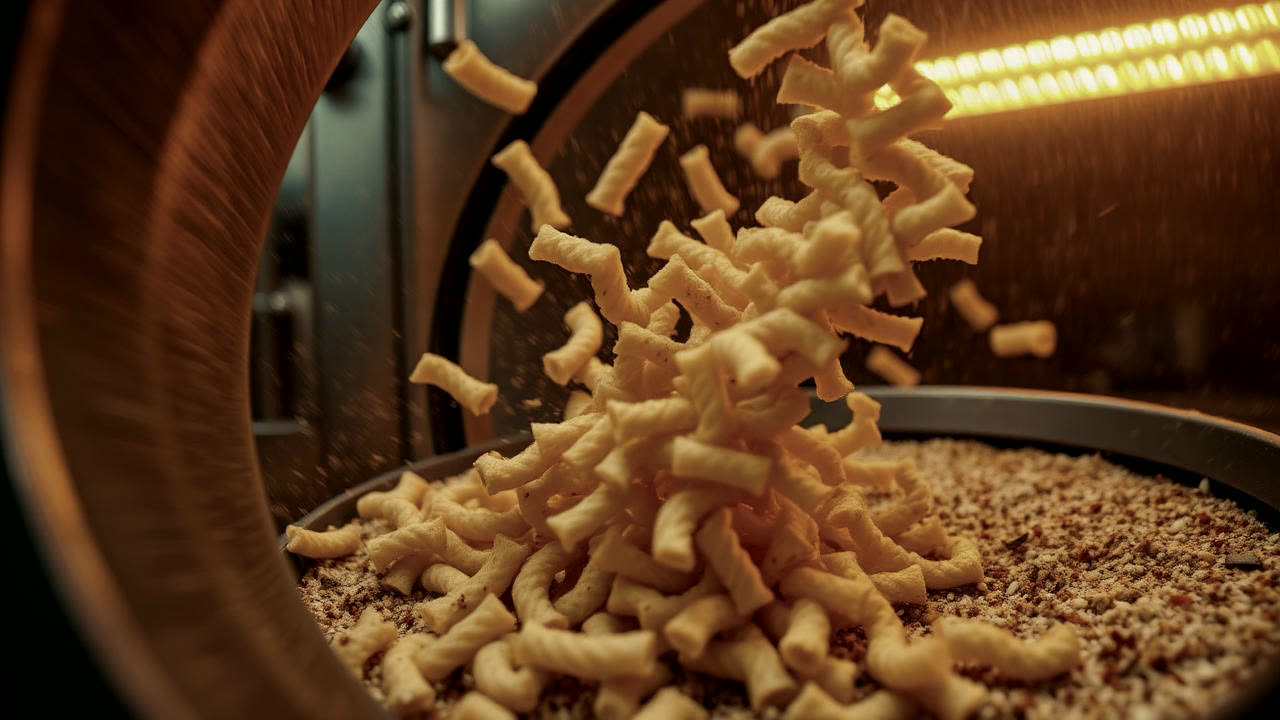
Hot product passes through a rotating seasoning drum where oil-soluble masala or dry seasoning is tumbled on for even coating.
De-oiling and cooling
Centrifugal de-oiling brings surface oil down to spec before the product cools on a conveyor to avoid sogginess in the pack.
Metal detection and packing
Product passes metal detection before nitrogen-flushed form-fill-seal packing to hold crispness through transit.
QC release
Moisture, oil content and seasoning uniformity are checked batch-wise before the lot is released for dispatch.
What drives the cost
depends
Base ingredient choice
Potato and multigrain bases cost more per kg than corn or besan, shifting the per-pack price by several rupees.
raises cost
Seasoning complexity
Multi-spice or dry-fruit seasonings need more dosing stations and raise ingredient cost per pack.
raises cost
Oil type
Premium oils (rice bran, sunflower vs palm blends) add cost but change shelf taste profile.
raises cost
Pouch film
Higher-barrier metallised film extends shelf life but costs more than plain BOPP laminate.
lowers cost
Batch size
Longer production runs amortise die changeover and line cleaning time across more packs.
raises cost
Nitrogen flushing
Nitrogen flush packing adds a small per-pack cost but reduces oxidative rancidity and crush damage.
Common mistakes first-time brands make
Skipping oil stability testing
Brands that don't check peroxide value trends over shelf life see rancidity complaints after a few months on shelf.
Underestimating die lead time
Custom extruder dies for a unique shape can take 3–4 weeks to fabricate, which brands often forget to budget into timelines.
Ignoring seasoning drum capacity
A seasoning formulation tested on a small drum doesn't always coat evenly at full production scale, leading to patchy flavour.
Underpacking against crush
Thin pouch films or loose fill weight cause breakage of extruded curls in transit, driving returns.
Choosing a manufacturer for namkeen and extruded snacks
Extrusion and frying capability
Confirm the plant runs both single/twin-screw extruders and continuous fryers if your range spans both snack types.
Certifications
FSSAI licence is mandatory; FSSC 22000 or GMP certification signals tighter hygiene control for ready-to-eat snacks.
Capacity and changeover
Ask how many SKUs run per shift and how long die or seasoning changeovers take, since this affects your MOQ economics.
Sampling process
Request seasoning and texture samples from an actual production-scale batch, not a lab trial, before locking formulation.
Frequently asked questions
- Can I launch with multiple seasoning variants at a low MOQ?
- Yes, most plants allow 2–3 seasoning variants off the same base batch once the fryer or extruder run is set, keeping per-variant MOQ lower than starting a fresh base each time.
- How long does namkeen stay crisp after packing?
- Typical shelf life is 4–6 months in a metallised, nitrogen-flushed pouch stored away from humidity; plain BOPP pouches shorten this.
- Does extruded snack oil content affect cost significantly?
- Yes, oil content and type are among the largest cost drivers after the base ingredient, and also affect perceived crunch and aftertaste.
- What licence is mandatory before manufacturing starts?
- An FSSAI manufacturing licence is required; many buyers also look for GMP or FSSC 22000 certification as an added quality signal.
- Can I test a new shape before committing to full production?
- Most extrusion lines can run a short trial batch with your die to validate shape and bite before a full commercial run is scheduled.
How BrandForge helps
BrandForge takes your snack brief once and matches it double-blind against verified extruders and namkeen manufacturers whose line capability and seasoning expertise fit your shape and flavour plan. Names are revealed only after both sides approve the match, and a success manager stays involved through the first production run.