Manufacturing guide · Food
Sauces and ketchup contract manufacturing in India
Sauces and ketchup typically launch at an MOQ of 5,000–15,000 bottles of 500 g, with ex-factory cost of ₹30–55 per bottle depending on tomato solids content, preservative-free positioning and bottle type. Lead time is usually 6–10 weeks from recipe finalisation to first batch, and an FSSAI licence with consistent viscosity and Brix control are the key quality levers. Hot-fill or cold-fill choice at the filler stage has a direct bearing on both shelf life and bottle cost.
Key facts
| Typical MOQ | 5,000–15,000 bottles of 500 g per SKU |
|---|---|
| Typical pack sizes | 200 g, 500 g, 1 kg glass bottle; 1 kg pouch for catering |
| Indicative cost per unit | ₹30–55 per 500 g bottle, ex-factory |
| What the cost covers | Ex-factory: tomato paste/ingredients, cooking, glass bottle and cap included; excludes GST, freight, outer cartons, brand margin |
| Lead time, brief to first batch | 6–10 weeks from recipe finalisation to first batch |
| Key licences and certifications | FSSAI licence; product must meet applicable FSSAI category standards; Legal Metrology labelling for pre-packaged goods |
| Typical shelf life | 9–12 months unopened; 4–6 weeks refrigerated after opening |
| Common formats | Glass bottle, PET squeeze bottle, flexible sachet/pouch |
How it is made
Ingredient preparation
Tomato paste or pulp, spices and sweetener/acidifier are weighed to the recipe; paste concentration is checked before cooking begins.
Cooking and reduction
The mix is cooked in a steam-jacketed kettle to the target Brix (soluble solids), with continuous stirring to avoid scorching at the kettle base.
Homogenisation
The cooked sauce is passed through a homogeniser to achieve a smooth, consistent texture free of particulate separation.
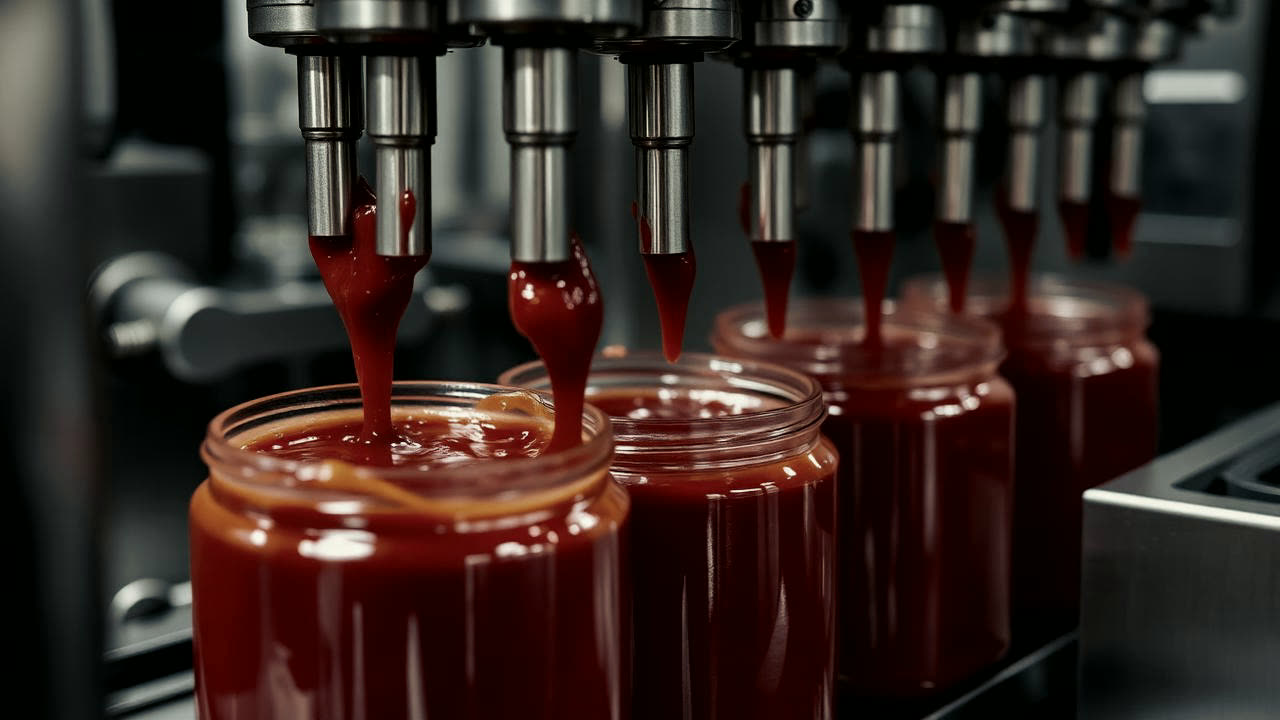
Hot filling
Sauce is filled into bottles at a controlled hot temperature to achieve an in-pack pasteurisation effect before capping.
Capping and cooling
Bottles are capped immediately and inverted briefly to sanitise the cap and neck area, then cooled gradually to avoid glass stress cracks.
Labelling and QC release
Viscosity, Brix and pH are checked against spec before labelling and dispatch.
What drives the cost
raises cost
Tomato solids content
Higher tomato paste concentration gives a thicker, richer sauce but raises the raw material cost share significantly.
raises cost
Preservative-free formulation
Removing chemical preservatives often needs higher acidity or hot-fill process control, adding to formulation and process cost.
depends
Bottle type
Glass bottles cost more than PET but are often preferred for premium positioning and better flavour barrier.
raises cost
Viscosity target
A thicker, table-sauce consistency needs longer cook times and more energy per batch than a thin cooking sauce.
lowers cost
Batch size
Larger kettle batches spread cooking energy and cleaning time cost across more bottles.
raises cost
Cap and closure type
Tamper-evident flip-top or squeeze caps cost more than a standard screw cap but improve shelf usability.
Common mistakes first-time brands make
Underestimating Brix control
Batches cooked without tight Brix monitoring vary in thickness pack to pack, which buyers notice quickly.
Skipping hot-fill validation
Filling below the validated hot-fill temperature risks inadequate in-pack pasteurisation and shortens shelf life.
Choosing the wrong cap liner
A cap liner not suited to acidic sauce can corrode or leach, affecting both seal integrity and taste over shelf life.
Ignoring post-opening shelf life
Brands often label only unopened shelf life and skip guidance on refrigeration after opening, which affects customer experience.
Choosing a manufacturer for sauces and ketchup
Cooking and filling capability
Confirm the plant has steam-jacketed kettles sized for your batch and a validated hot-fill line for your bottle format.
Certifications
FSSAI licence is mandatory; FSSC 22000 or ISO 22000 certification signals more consistent process control for acidified foods.
Capacity and kettle size
Ask about kettle batch size in litres, since this sets your practical minimum run per cooking cycle.
Sampling process
Request a hot-filled sample bottle, not just a lab-cooked sample, to check real seal and texture performance.
Frequently asked questions
- What makes sauce shelf-stable without refrigeration before opening?
- A combination of Brix (sugar/solids concentration), acidity and hot-fill in-pack pasteurisation keeps unopened sauce shelf-stable for 9–12 months.
- Can I launch a preservative-free ketchup?
- Yes, though it usually needs tighter acidity control and process validation, which can raise both formulation cost and lead time slightly.
- Does bottle type affect cost much?
- Yes, glass bottles typically cost more than PET but are commonly chosen for flavour barrier and premium shelf appeal.
- How long does ketchup last after opening?
- Typically 4–6 weeks under refrigeration, though this depends on the specific preservative and acidity level in the formulation.
- What licence is required to manufacture sauces in India?
- An FSSAI manufacturing licence is mandatory, along with Legal Metrology compliance for net-weight labelling on the pack.
How BrandForge helps
BrandForge matches your sauce brief double-blind to manufacturers with kettle and hot-fill capability suited to your viscosity target and bottle choice, cutting down the back-and-forth on process fit. A success manager stays engaged once both sides approve the match, through the first hot-filled batch and shelf-life sign-off.