Manufacturing guide · Food
Peanut butter contract manufacturing in India
Peanut butter typically launches at an MOQ of 5,000–12,000 jars of 340 g, with ex-factory cost of ₹70–130 per jar depending on peanut roast profile, added oil/stabiliser level and whether the product is crunchy or creamy. Lead time runs 6–10 weeks from recipe finalisation to first batch, and an FSSAI licence with aflatoxin testing on incoming peanuts is a non-negotiable quality gate. Grinding temperature and oil separation control are what most affect texture consistency on the shelf.
Key facts
| Typical MOQ | 5,000–12,000 jars of 340 g per SKU |
|---|---|
| Typical pack sizes | 200 g, 340 g, 500 g, 1 kg jar; stand-up pouch for value packs |
| Indicative cost per unit | ₹70–130 per 340 g jar, ex-factory |
| What the cost covers | Ex-factory: roasted peanuts, oil/stabiliser, grinding conversion and glass/PET jar included; excludes GST, freight, outer cartons, brand margin |
| Lead time, brief to first batch | 6–10 weeks from recipe finalisation to first batch |
| Key licences and certifications | FSSAI licence; product must meet applicable FSSAI category standards; Legal Metrology labelling for pre-packaged goods |
| Typical shelf life | 9–12 months unopened at ambient temperature |
| Common formats | Creamy, crunchy, natural (oil-separating) and stabilised no-stir variants |
How it is made
Peanut sorting and roasting
Raw peanuts are cleaned, sorted to remove discoloured kernels and roasted in a continuous roaster to the target colour and aroma profile.
Blanching and cooling
Roasted peanuts are blanched to remove skins and cooled before grinding, since residual heat affects oil release during milling.
Stone grinding
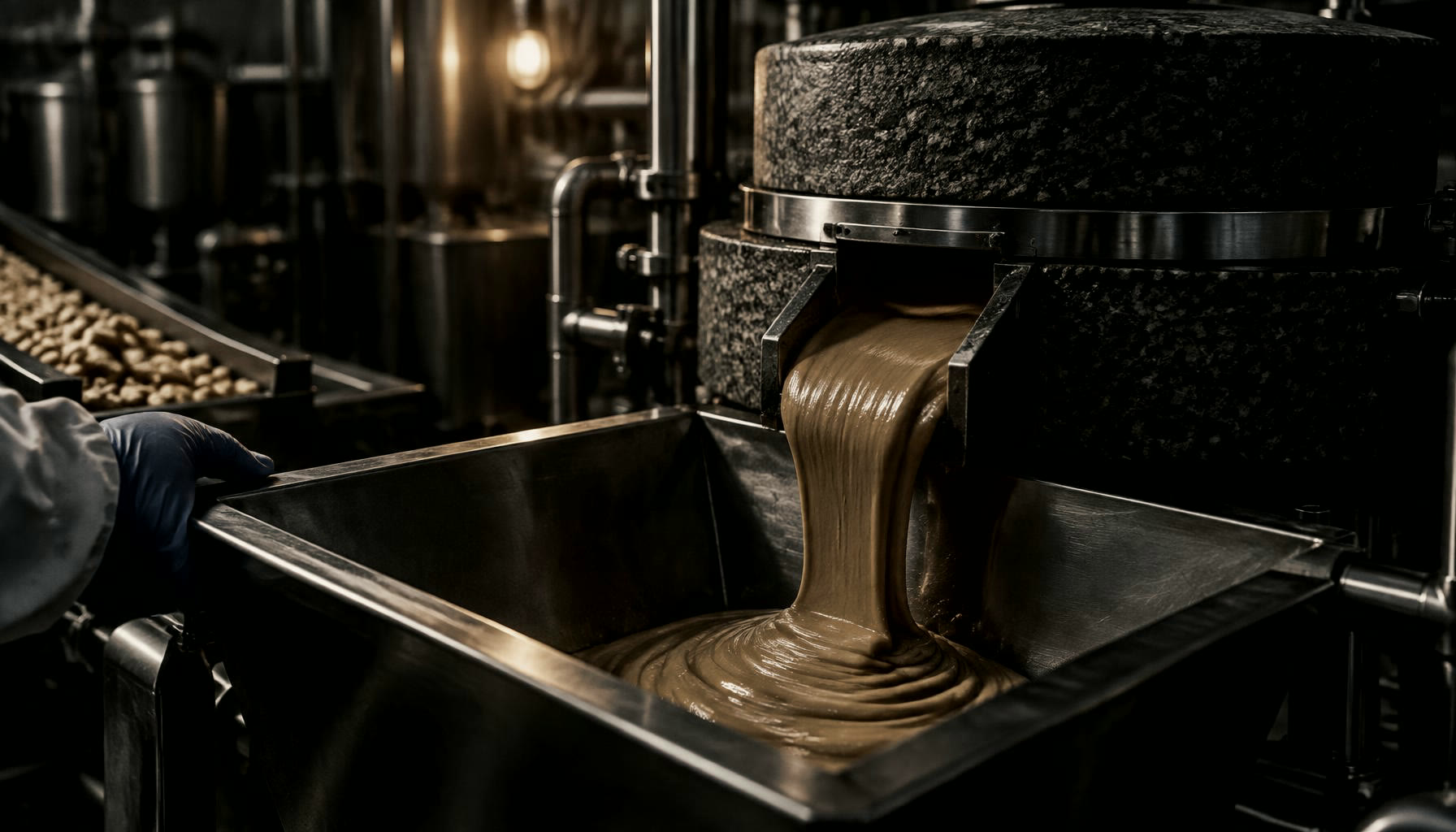
Peanuts pass through a stone grinder (or colloid mill) that breaks them down into a smooth paste, with temperature monitored to control oil separation.
Formulation and mixing
Salt, sweetener, stabiliser (for no-stir variants) or added peanut pieces for crunchy texture are blended into the paste in a jacketed mixer.
Hot or cold filling
Paste is filled into jars at a controlled temperature; hot filling helps with de-aeration and fill consistency for thicker pastes.
Capping, cooling and QC release
Jars are capped, cooled and checked for texture, oil separation and peanut aroma before release.
What drives the cost
raises cost
Peanut grade and aflatoxin testing
Peanuts sourced with tighter aflatoxin screening cost more per kg but are essential for food safety compliance.
depends
Stabiliser use
Adding stabiliser to prevent oil separation raises ingredient cost slightly but reduces consumer complaints about stirring.
raises cost
Roast profile
A darker, more developed roast needs tighter roaster control and slightly longer processing time per batch.
depends
Crunchy vs creamy
Crunchy variants need an added peanut-piece dosing step, which adds a small per-jar cost over plain creamy paste.
raises cost
Jar material
Glass jars cost more than PET but are often chosen for shelf premiumness and better oil-barrier properties.
lowers cost
Batch size
Larger grinding and mixing batches spread stone-mill cleaning and changeover cost across more jars.
Common mistakes first-time brands make
Skipping aflatoxin testing
Peanuts are particularly prone to aflatoxin contamination, so batch-wise testing of incoming lots should never be skipped to save cost.
Overheating during grinding
Grinding too fast or too long can raise paste temperature enough to darken flavour and increase oil separation beyond spec.
Underestimating no-stir formulation complexity
Stabilised, no-stir peanut butter needs careful stabiliser dosing; getting this wrong leads to either a grainy texture or excess oil pooling.
Choosing an undersized jar neck
A narrow jar neck makes crunchy peanut butter hard to scoop and spread, hurting the consumer experience despite good product quality.
Choosing a manufacturer for peanut butter
Grinding equipment
Confirm the plant uses a stone grinder or colloid mill suited to peanut butter's oil content, not a generic spice or sauce mill.
Certifications
FSSAI licence is mandatory; look for aflatoxin testing protocols and FSSC 22000 certification as added assurance.
Capacity and batch size
Ask about mixer and filler batch size, since peanut butter's viscosity often limits how fast a line can run compared to thinner products.
Sampling process
Request a jar from an actual production batch after a few weeks of ambient storage to check for oil separation before approving the recipe.
Frequently asked questions
- Why is aflatoxin testing so important for peanut butter?
- Peanuts are naturally susceptible to aflatoxin contamination during growing and storage, so batch-wise testing of incoming peanut lots is a standard, non-negotiable quality step.
- What's the difference between natural and stabilised peanut butter in production?
- Natural peanut butter skips stabiliser and separates oil naturally over time, while stabilised variants need precise stabiliser dosing during mixing to stay smooth without stirring.
- Does crunchy peanut butter cost more to make?
- Slightly, since it needs an added dosing step for peanut pieces after the main paste is ground, though the ingredient cost difference is small.
- How long does peanut butter last unopened?
- Typically 9–12 months at ambient temperature when properly roasted, ground and filled, though natural variants may be labelled shorter due to oil separation.
- What jar type is commonly used?
- Both glass and PET jars are used; glass is often preferred for premium positioning and better oil-barrier performance over the shelf life.
How BrandForge helps
BrandForge matches your peanut butter brief double-blind to manufacturers with the right grinding setup and aflatoxin testing protocols for your target texture, whether natural or stabilised. Once both sides approve the match and names are shared, a success manager follows the first batch through shelf-storage checks with you.